

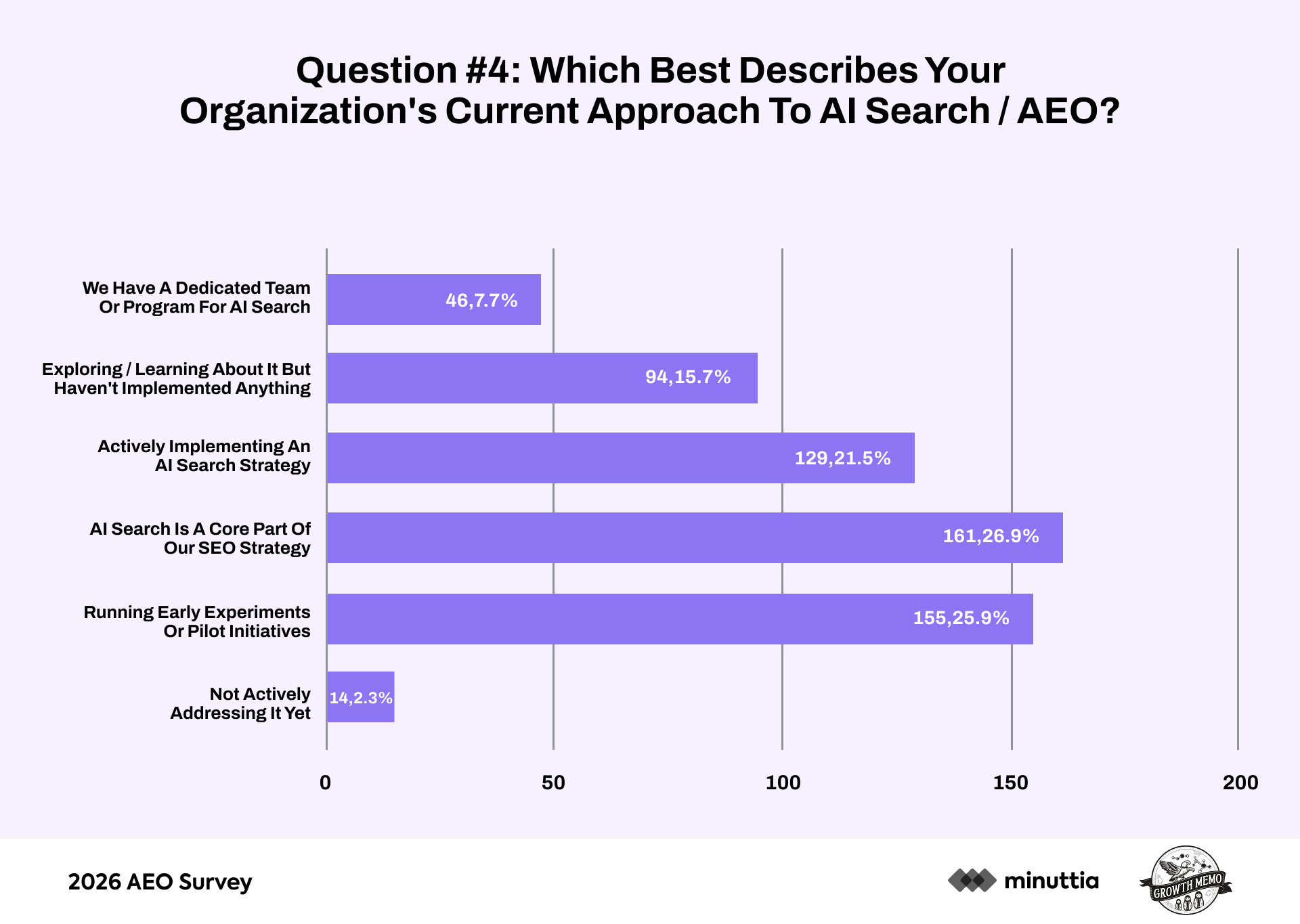
George Chasiotis has spent close to a decade in SEO, most of it as the person clients call when their content engine stalls. Last year he and Kevin Indig surveyed almost 600 marketers on the state of AI search.
Soon after, we went together to Athen’s biggest business forum at Panathenea, and there I had the opportunity to set my camera and interview him.
George is the founder of Minuttia, a content and SEO shop built for B2B SaaS.
We have worked together on multiple projects, most saw great success, including the on we run on LearnWorlds, I spoke about it in my presentation in Start-up to Scale-up here.
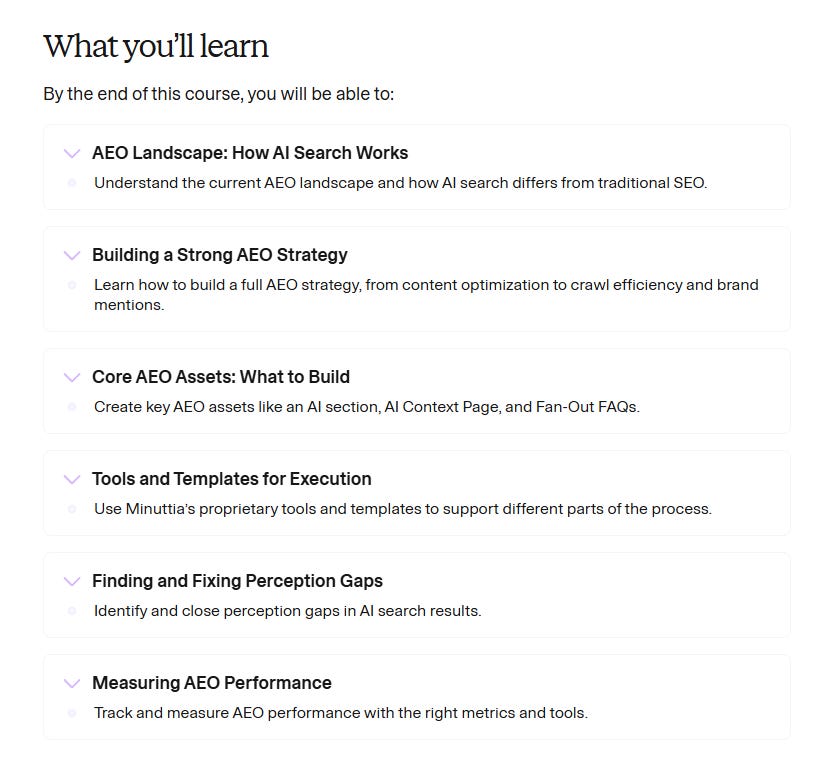
Use coupon code NICK10 to get 10% off Minuttia’s AEO Course.
In this episode, you will hear us discuss
Why George stopped calling AI search a new channel
The answer 40% of marketers gave when asked about their biggest AEO problem
The gap between doing AEO and knowing what you’re doing
Where backlinks fell to, and what sits above them now
The math for defending a 5K per month AEO budget to your CFO
How to check whether your buyers are even on AI search
What Minuttia actually reports back to clients
AEO is an extension of search, not a new channel
George’s position is that the overlap between traditional search and AI search runs deep. Deep enough that treating AEO as a fresh start is a mistake.
Picture SEO as a pyramid.
The base holds up everything above it, and most of that base did not move.
What still counts:
topic breadth, and depth.
Publishing velocity.
Topical authority.
Content monitoring…
…which matters more now that study after study shows AI systems favor fresh content.
The building blocks of content optimization. Crawl efficiency and accessibility, with one nuance.
Do not block the crawlers that feed AI.
CCbot pulls the Common Crawl dataset, and Common Crawl sits inside the training corpus of most of the systems you are trying to show up in.
My metaphor about SEO vs AEO:
SEO and AEO are the same set of glasses. The difference is how full each one is. For SEO you pour more into backlinks. For AEO you pour more into citations and brand mentions.
SEO & AEO are at least at 80% the same work, but different quantities of each tactic to affect it. A few differences exist, but doing great SEO means you are 80% at great AEO.
Author’s note: I keep returning to this framing because it kills the reset instinct. Teams hear “AI search” and want to burn the old playbook and buy new tools. The work is mostly the same work, reweighted. I made the data case for that in AI vs SEO & PPC: What the Data Says. Nothing George said moved me off it.
Measurement is not Solved. Read it Directionally.
Ask George for the biggest surprise in the survey and he goes straight to measurement.
Question 15 asked marketers to name their hardest problem.
Around 40.6% said measurement and attribution.
His read is blunter than the number. With the tools that exist today, measuring AEO properly is not possible.
AI engines mask the sessions they send you.
Referral traffic shows up as something else, or as nothing.
And that is one touchpoint.
Someone reads an answer in ChatGPT, opens Google two days later, lands on your site as direct a week after that because they remembered your name.
You will never draw a clean line through that path.
It behaves like dark social.
Your real AI-influenced traffic is almost certainly higher than what the dashboard shows.
Then there is the board problem. Leadership hears AI search is a thing, hands over budget, and three months later asks for the ROI.
Author’s note: This is the oldest fight in marketing wearing a new jacket. The best work rarely leaves a clean attribution trail. I wrote the long version in Measuring Brand Performance - The Hard Truth, leaning on Rory Sutherland’s line that marketers are opportunists and CFOs are optimizers. AEO just handed both sides a fresh thing to argue about.
80% are Doing it. Almost Nobody is sure.
The survey found close to 80% of companies actively working on AI search, either in early experimentation or as core to their efforts. High number.
Then it asked how confident they felt about that work, and the confidence dropped.
George’s theory, and he is careful to call it a theory, is that people confuse activity with competence.
SEOs are doing things.
Doing things gets mistaken for knowing things.
Some of that motion is real experimentation, which is how you are supposed to operate in a channel this young. Some of it is motion staged to show a manager motion.
Out of that, three types of company keep surfacing in his calls:
Panic, no change. They have the mandate from the CMO or the board. They take agency calls, spend everyone’s time window-shopping, and change nothing.
Same playbook. No panic. They run their 2020 SEO motion untouched and assume it transfers.
Willing to change. The smaller group. They treat the environment as moving and make decisions that account for the movement.
Only the third group compounds.
Author’s note: This maps to something I have argued before. The edge right now is effort and willingness to run experiments, not access to a secret. I made that case in The New Competitive Moat: Effort. The panic companies and the same-playbook companies are both standing still, for opposite reasons.
What ranks now, and where backlinks fell to
Here is where George reorders the furniture.
For years, backlinks were the whole game.
In AI search he drops them to the tip of the pyramid, least important of the things that still matter, though correlated, since pages with more links tend to get pulled into the search features these systems run when they research a query the way you or I would.
His hierarchy, top to bottom:
Brand experience. What it actually feels like to use your product. If your support response times are bad, no volume of ghostwritten Reddit accounts saves you. The bad experience overflows and spreads. You cannot hide it.
Owned perception. Your site, your social handles, the directories you manage.
Multi-channel perception. The mentions you do not engineer. A Reddit thread about your brand, positive or negative.
Backlinks. Still there. No longer the point.
More brand mentions and citations for AEO, more backlinks for SEO. Same activities, different weightings.
Is $5K a Month for SEO/AEO Worth it?
George opened with “it depends,” which is the correct answer.
Drop traffic as the unit.
Use average selling price times the number of people you influence.
An e-shop at 100 dollars ASP influencing 100 people a month makes 1,000 dollars off a spend that costs more than that.
Thin.
An enterprise product at 100K ASP influencing one or two buyers can justify a new customer a quarter on 5K a month, which is triple ROI.
The economics flip entirely with the price of what you sell.
One condition sits before the math.
Your buyers have to be on AI search in the first place.
A dev tool selling to engineers can safely assume its audience lives in ChatGPT, Claude, and the rest.
The honest part came last. When a CEO or CFO asks for an ROI number on a channel this new, that number is a well-educated guess.
A calculated risk…
Wrapping up
Six things I took from this one.
AEO is reweighted SEO.
Read AI search numbers as a floor. The influence is larger than the dashboard shows.
Audit whether you are still using the same playbooks.
Check that your ICP is on AI search before you spend a $/€ on it.
Price the risk with ASP, tell your CFO it is a calculated guess, and mean it.
Brand experience sits above everything.
George’s closing line held the whole hour in one sentence.
“Take all these things directionally, not at face value.”
That is the job.
Read the signal, size the risk, keep moving.


