

I sat down with Shiyam Sunder, founder of Slate and CEO of TripleDart, for a live demo of the platform his team has been building for B2B SaaS SEO and content teams.
This was not a marketing call. I booked time on his calendar to evaluate Slate as a potential buyer.
The conversation that follows is what a senior practitioner sounds like trying to figure out whether a piece of software
actually solves a real problem at scale,
what it costs, and
who it’s actually built for (ok, this is more professional curiosity).
About Shiyam & Slate
Shiyam runs TripleDart, a growth marketing agency for B2B SaaS, and built Slate (slatehq.com) on the back of the content automation problems his agency was already solving for clients.
The product solves problems content teams actually have, first for the team at TripleDart.
It is an automation tool with pre-built workflows on content automation, updates, and content management at scale, with a human-in-the-middle approach to AI.
In this episode, you will hear us discuss:
What Slate actually is (and what it isn’t)
The live demo
The differentiator from tools like N8N and Make
The credit pricing model, what $500 actually buys, and how Slate set its prices
Who Slate is built for (Spoiler: 1,000-page minimum sites)
What Slate Actually Is (and What It Isn’t)
The first thing Shiyam wanted to clarify on the call was the positioning, because it gets confused often. Slate is not an AI search tool.
It is not Profound, Peec, or Athena.
It is a content automation platform built around composable AI actions, what Shiyam calls “nodes.”
You build agents.
The agents run sequences of nodes.
The nodes generate images,
pull keyword data from Ahrefs and Semrush,
take screenshots of brand pages,
write articles,
do internal linking,
do external linking, and
publish to your CMS.
It’s like Clay, but for SEO and content workflows. You build a workflow once, then call that workflow as a single block inside another, bigger workflow.
The Live Demo: From Brief to Published Article
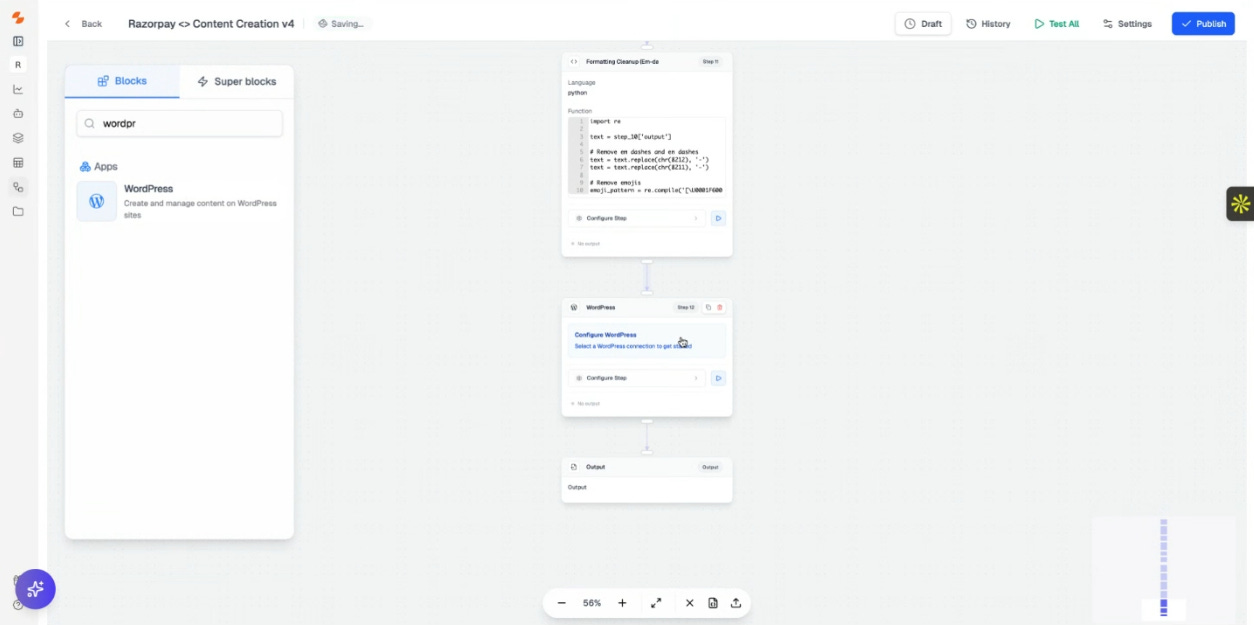
Shiyam walked through a real workflow built for Guideflow, a European SaaS company. The chain runs like this:
Take an input brief
Generate a hero image with GPT-image
Run a fact-checker node to find fresh statistics on the topic
Extract brand URLs from the brief
Take screenshots of those brand homepages
Map screenshots to brand mentions inside the article
Write the full article
Convert to clean HTML, flatten to a single file, generate a slug
Publish directly to Webflow under a new section of the blog
The end output is a published article with original images, embedded screenshots of competitor products and internal links.
How is this different from N8N or Make.
First, the blocks themselves.
Slate has SEO-native nodes that don’t exist in N8N like Ahrefs, Semrush, citation formatting, web search with AI overviews, schema generation, internal linking, external linking, content humanizer, Reddit scraper, G2 reviews scraper.
The general-purpose tools can technically do this, but you’re building it from scratch. Slate already has the functionality built-in.
Second, every block is structured to take a prompt for both the AI agent and the end user. Slate’s blocks have a dual prompt by design with instructions for the system, and instructions for the human reviewer.
That distinction matters more than it sounds. I tend to prefer workflows with the human-in-the-middle-loop.
Bulk Content Refresh and Internal Analysis
The use case that turns Slate from “interesting” into “I would actually buy this” is bulk content refresh.
If you have 10,000 pages and traffic is declining on 800 of them, the manual job is unbearable. Slate’s content refresh agent ingests an existing article, runs the analysis, and produces a refreshed version with modifications highlighted.
Yellow for sections it changed.
Green for sections it added.
You review, approve, and publish.
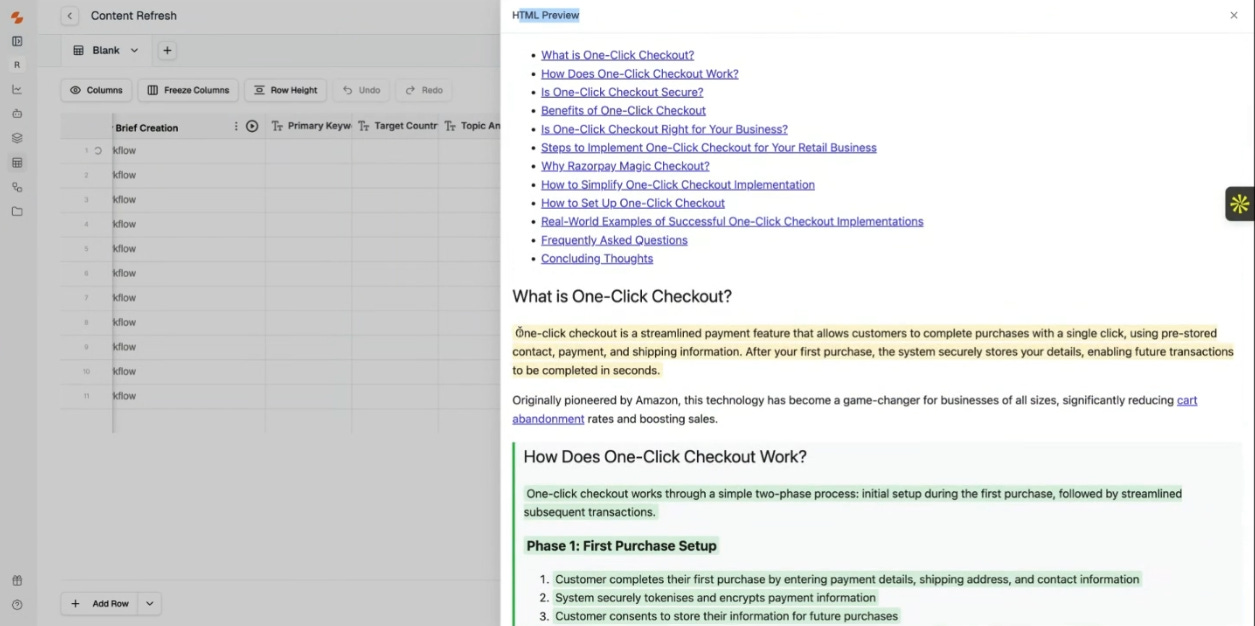
Razorpay, an Indian fintech directly competing with Stripe, has roughly 10,000 pieces of content and uses Slate to refresh 25 to 30 per week.
Atlas, a global payroll company, uses it to monitor every country’s official visa site and update their content every time visa rules change.
SentinelOne uses it to maintain a daily-updated repository of new cyber attacks.
Agentic Workflow Building
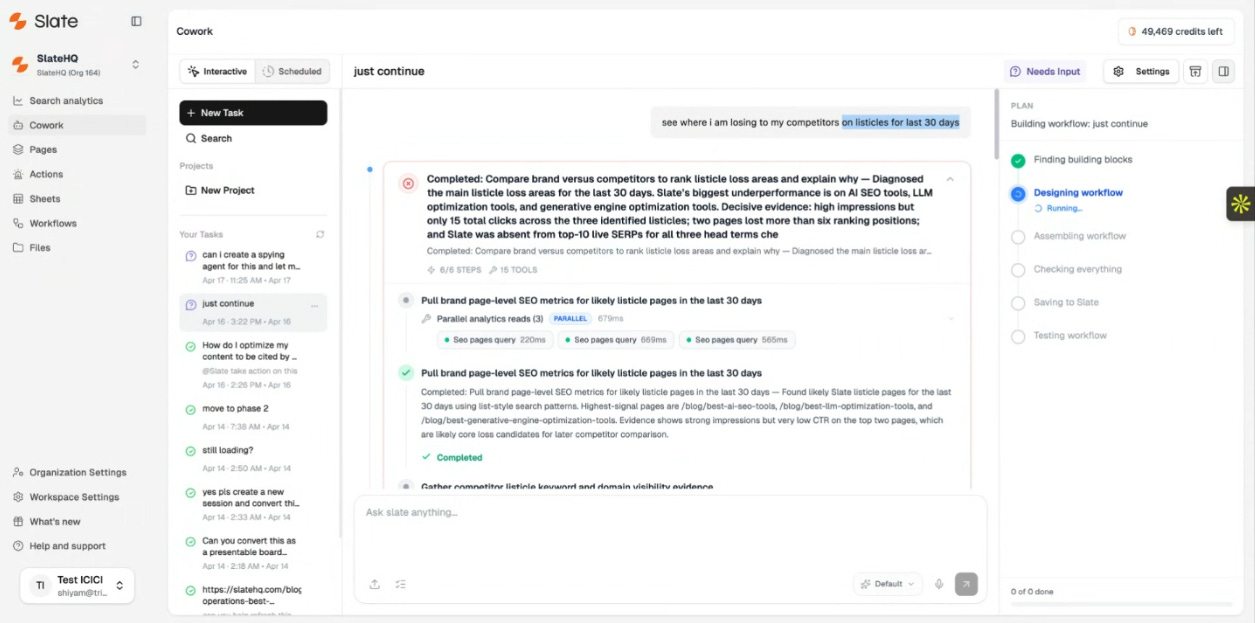
The internal analysis side is where Slate gets ambitious. Shiyam asked the platform a single question on the call: “Where am I losing to competitors on listicles in the last 30 days?”
The system pulled brand-level SEO metrics, gathered competitor listicle pages, ran a diagnosis on why specific pages were underperforming, and recommended refresh-or-rebuild for each one. Then he asked it to fix the problem. It built the refresh workflow on its own.
Pricing, Credits, and Who Slate Is Built For
This is where I pushed hardest, because Slate’s pricing isn’t on their site in a useful way and I wanted the practitioner answer.
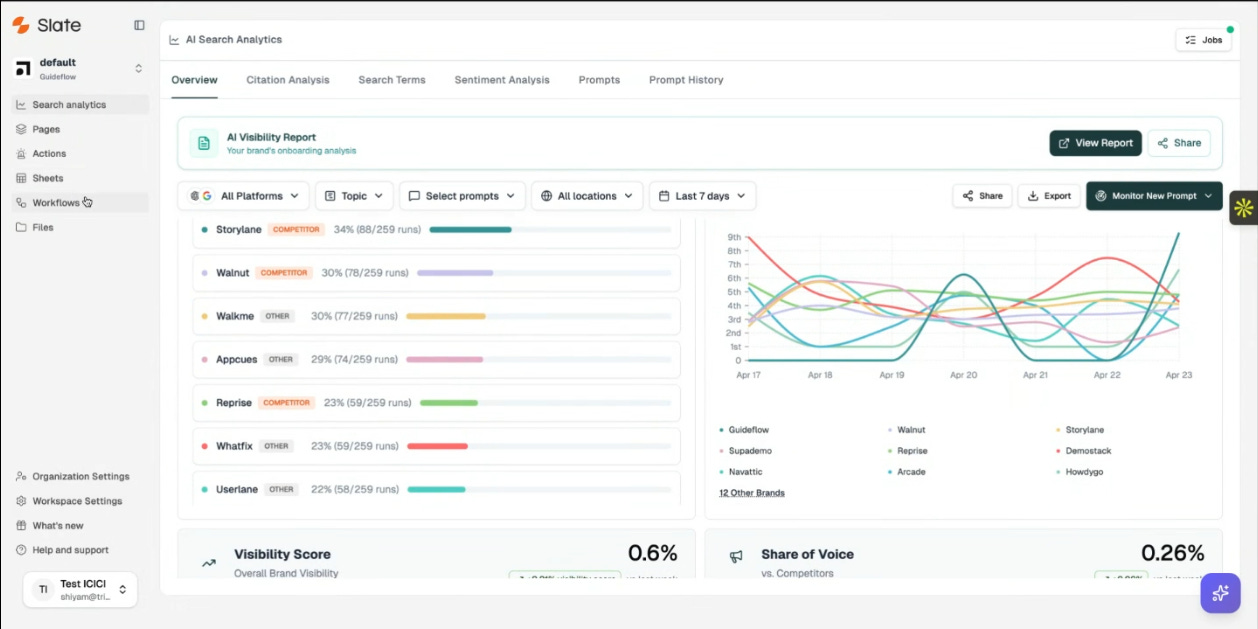
Slate uses a credit model.
Pricing
Workflows and agents (the main product)
Solo: $500 for 50,000 credits → roughly 30 to 40 content creation or refresh tasks, including image generation
Pro: $1,000 for 100,000 credits → more credits, more users, plus access to Sanity, Contentful, and additional CMSs (Solo only covers WordPress and Webflow)
Scaling up from there: $2,000 for 200,000 credits, $3,000 for 300,000
Prompt tracking (separate product, for AI search visibility monitoring)
100 prompts × 4 platforms × 4 weeks = roughly $199 to $299
I asked Shiyam how they set the price. The answer was unusually direct.
“Purely on our margins.”
Slate isn’t priced based on competitor benchmarks or willingness-to-pay testing. It’s priced as cost-plus on the underlying API and data fetching costs.
Not a Self-Service SaaS
There is no self-service.
I tried to use Slate before the call.
It does not work without setup.
The white-glove model is built-in to the system.
The company sets up your workspace, configures your CMS connections, and helps you build your first agents.
The Target Market: Enterprise
The target customer is mid-market or enterprise, with a minimum of 1,000 pages on their site.
Average ticket size: $10,000 to $25,000 a year. He has roughly 78 independent customers plus 20 from TripleDart’s agency book.
If you have 200 blog posts and traffic is fine, this is not for you. If you have 5,000 product pages and a content refresh problem nobody on the team has time to solve, this is exactly for you.
Takeaways
Three things stayed with me from this conversation.
Slate solves a real problem for the agency.
Pre-built AI workflows to create and refresh content at scale.
This is for big websites.
This is enterprise SEO automation, sold to teams that already have a content engine, and thousands of pages.
The pricing methodology is going to change.
Cost-plus margin is a good way to start, but I expect the pricing to change as it moves forward. Already, the credit limits have been expanded.


