

Earlier this year, I gave a presentation for SaaStock Athens.
This was my story as the first marketing employee at LearnWorlds, a startup of around $100k ARR when I joined that grew to $1M ARR before the second hire.
In this speech, I talk about growth hacking, and how startups create “luck”.
Because, growing a company has many ingredients:
Talent,
Timing,
Speed, and a bit of
Luck
And, all those should be wrapped around a great product.
P.S.: Subscribe to the newsletter, and you will get the presentation of the event as well!
Two Growth Spurts in 2017
For more than a year I kept trying to reverse-engineer what actually grew LearnWorlds in 2017. I kept checking our analytics, dashboards, data… for anything to explain our x4 growth that year.
It came down to two things, and they each accounted for roughly a quarter of revenue that year.
Affiliate #1
The first was a listing in Jeff Cobb’s Learning Revolution.
He was one of the top affiliates in the space, ranked first in Google for people searching for an LMS or course platform. He put us fifth on his list.
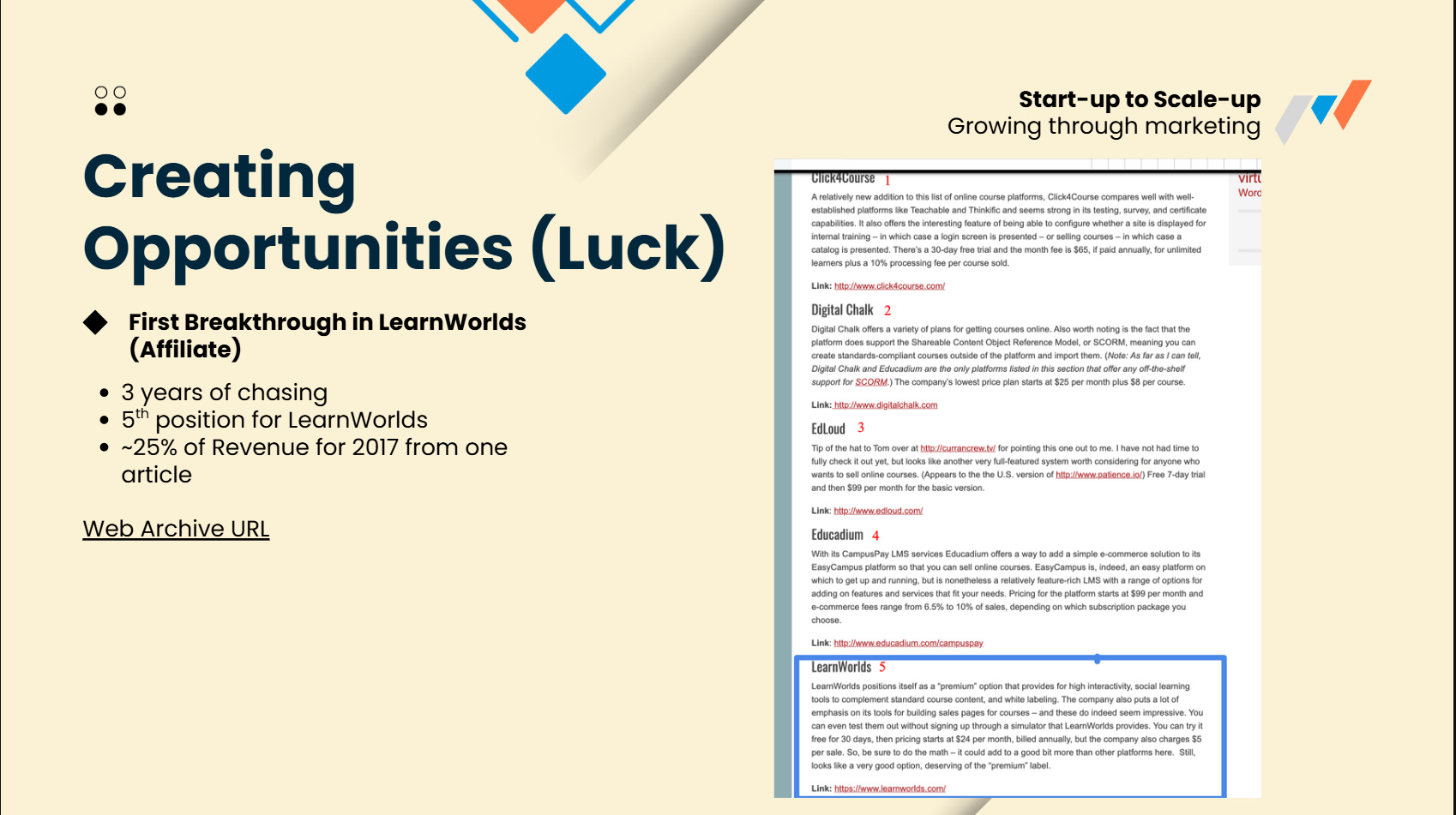
That single placement drove about 25% of LearnWorlds revenue in 2017, and you could see it in the data. The affiliate clicks, the mirrored lift in direct and organic that you could not attribute cleanly but lined up too perfectly to be anything else.
That looks like luck.
It was not.
Panos chased that listing for 3 years.
Emails, LinkedIn messages, comments on his content.
There is a comment from Panos two years before I even joined, asking to be added to the list.
Investing in Marketing
The year it finally happened was the year we were also investing in the team and in marketing across the board.
The opportunity was created.
The second 25% came from a Forbes article that landed around the same time.
Same effect.
Direct and organic traffic moving in a way attribution could not explain, but the timing was unmistakable.
The COVID Effect: Timing
Then COVID hit, and everything quadrupled. Leads, trials, revenue. Every company in the world suddenly needed to sell courses or run internal training online.
COVID created the demand.
Marketing captured it.
We had spent two years on SEO with Minuttia.
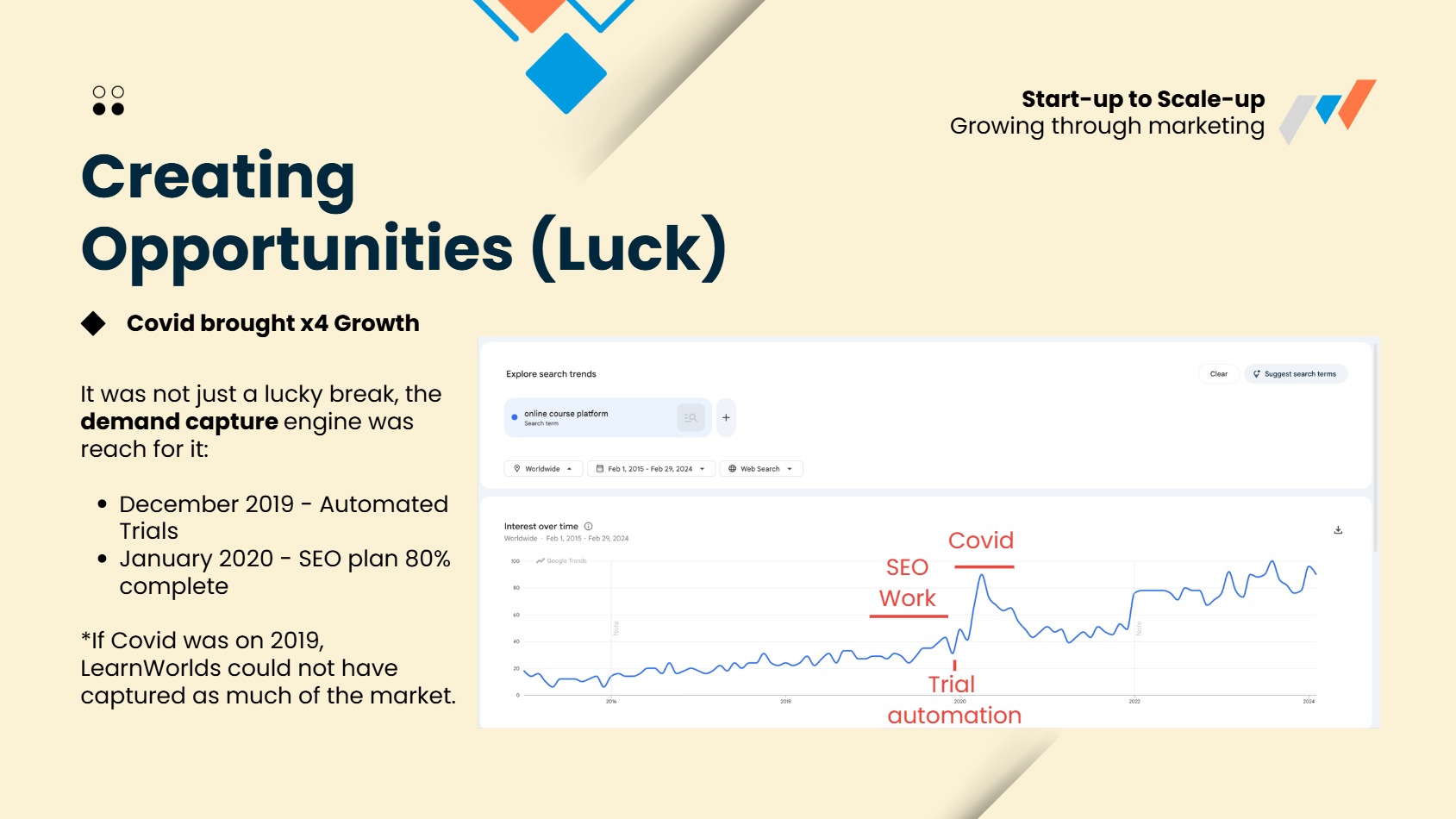
By December we had about 80% of the SEO plan executed and LearnWorlds was ranking first to fifth on most of the keywords that mattered.
When the market quadrupled, that inbound organic traffic just landed on us.
If we had not done those two years of unglamorous SEO work, we would have lost at least half of the industry’s growth, or paid affiliates the same money to recover it.
If you only take one operational idea from this: demand generation and demand capture are separate disciplines, and the second one has to be built before the spike, not during it.
Product Back-end Story
You might think marketing generates growth.
However, up until November 2019, our CTO was creating every single trial by hand. A request would come in, and within 24 hours he would manually create the account, send the email, and walk people through.
Enormous friction.
If that process had still been manual when COVID hit, he would have been burnt on the first month, and we couldn’t have served the clients.
That bottleneck was removed 4-5 months before the lockdowns started.
Speed is a Growth Hack
When you are small, speed is your only structural advantage against larger competitors.
Doing more things, faster, means more opportunities.
More opportunities means more chances that one of them goes big.
Most will fail.
If you are not comfortable with chaos, failure, and experimentation, growth hacking is not for you.
Working with limited data, being fast, and spending budgets on big risks.
This is also why I push back hard on the “great product sells itself” belief, especially with technical founders.
A valuable product with no promotion and no distribution does not reach its potential.
The team and the execution are what investors actually evaluate, and they are what turns a good product into a growing one.
Effort is the moat now, not the product spec. I wrote about why the bar moved from volume to effort here:

Some Growth Hacks are Internal
A quick story from Cyberbit.
It took me five days to onboard a freelance agency I needed for performance.
A colleague told me that normally takes two months because of legal and approvals.
To me, five days was already an eternity.
I was used to two emails and done.
Recently I spent three days fighting finance to approve software we need, specifically so we could start that work on Monday instead of in April or May.
This is actually growth hacking for B2B, being able to move faster.
Side Story from a Friend
A client they work with at a big SaaS, in order to go faster often approved smaller projects and budgets by his personal one.
$1k-$2k add-ons on services per month did not need approvals by the CFO.
This allowed them to move fast.
When the time for the invoice came, the CMO had to defend the decision and explain the invoice. Due to having enough internal political capital, it took a couple of days to greenlight and a personal chat to the CFO.
Move fast first, fix it later.
Bottlenecks, Growth Hacks, and Startups
Luck is real.
Speed is important.
It’s all in the recipe for success.
Building luck through quick actions is important. Just, keep in mind that if you don’t have good decision-making or taste, speed is going to kill your business faster.
The blade cuts on both sides…
P.S.: Subscribe to the newsletter, and you will get the presentation of the event as well!


