
The Year of Trust Evaluated - Hits & misses of my 2026 Predictions so far

My predictions for 2026 aged like a fine wine 🍷
Ok, maybe not all, but I am pretty happy with 8 months in, seeing many of my predictions coming true, and I expect 1-2 more by the end of the year or at some point in 2027.
Back in December 2025 (a century ago it feels like), I published my predictions and named 2026 the Year of Trust.
Mostly true, I stand with my evaluation.
Trust is the most important thing among AI slop, and that’s why I wrote about the New MOAT: Effort.
Let’s go and evaluate them now :)
The hits
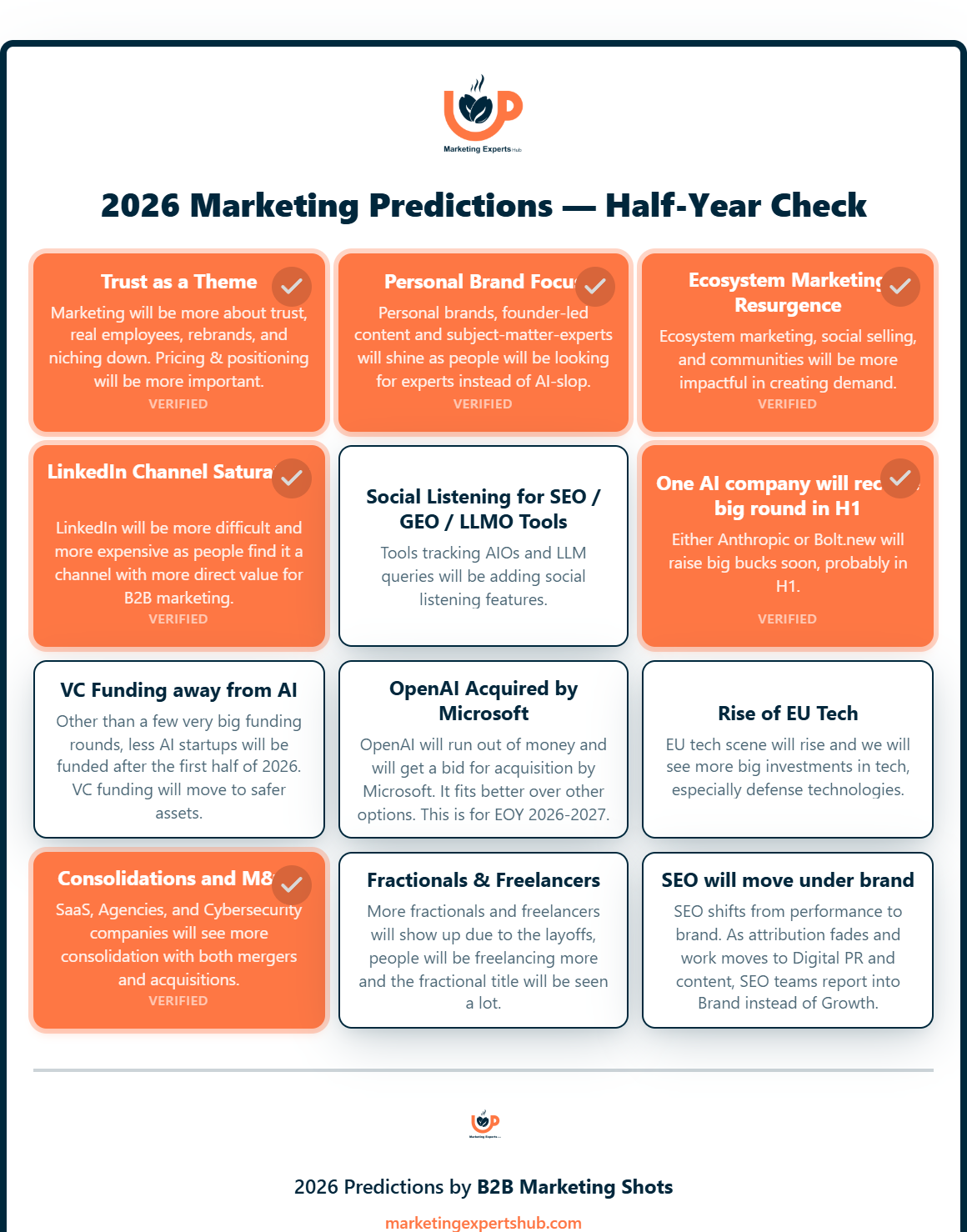
01. Trust as a theme
What I said: marketing moves back to basics. Positioning, pricing, and human-led content become the differentiators, and companies shift spend toward employees, rebrands, niching down, and pricing experiments.
The evidence:
Forrester predicted 75% of enterprise B2B companies would increase budgets for influencer relations (trust and brand signals) in 2026.
I would also add my empirical experience which led to the prediction, trust informs buying decisions, and people trust other humans in proximity to them.
Micro-influencers matter in decisions.
Brands matter in decisions.
Obvious AI creates distrust in brands.
AI slop erodes this trust, and people are tired. When people can’t differentiate due to oversaturation they tend to revert to the brands they know and trust.
02. Personal brand
What I said: founder-led content and employee subject-matter-experts win, because people will look for experts instead of AI slop. If your company does not have a public founder, you activate long-tenured employees and leaders instead.
The evidence:
Employee posts generate 8x more engagement than brand posts.
Thought Leader Ads run 2.68% CTR at $2.29 CPC, ~six times better than single-image ads.
I wrote about building a 15k Personal Brand on LinkedIn (now closer to 17k followers).
Founder-brands are doing better than anything else in organic social today.
People get more engagement than brands.
Employee advocacy and personal brands win in 2026.
03. Ecosystem
What I said: ecosystem marketing, social selling, and communities become more impactful for creating demand. Airtable, AirOps, Lovable, Clay, and Attio are already doing it and winning.
The evidence:
Clay created the Solutions Partner Program for GTM engineers, consultancies and agencies. Doubling down on the ecosystem/community play.
Agencies now issue press releases about joining their Clay Solutions Partner Program. Example by demandDrive which announced its Clay Studio Partner designation in May 2026.
n8n community and integrations, as well as community-build templates are the main drivers of growth.
Lovable launched it’s ambassadors host meetups, every employee is also an ambassador.
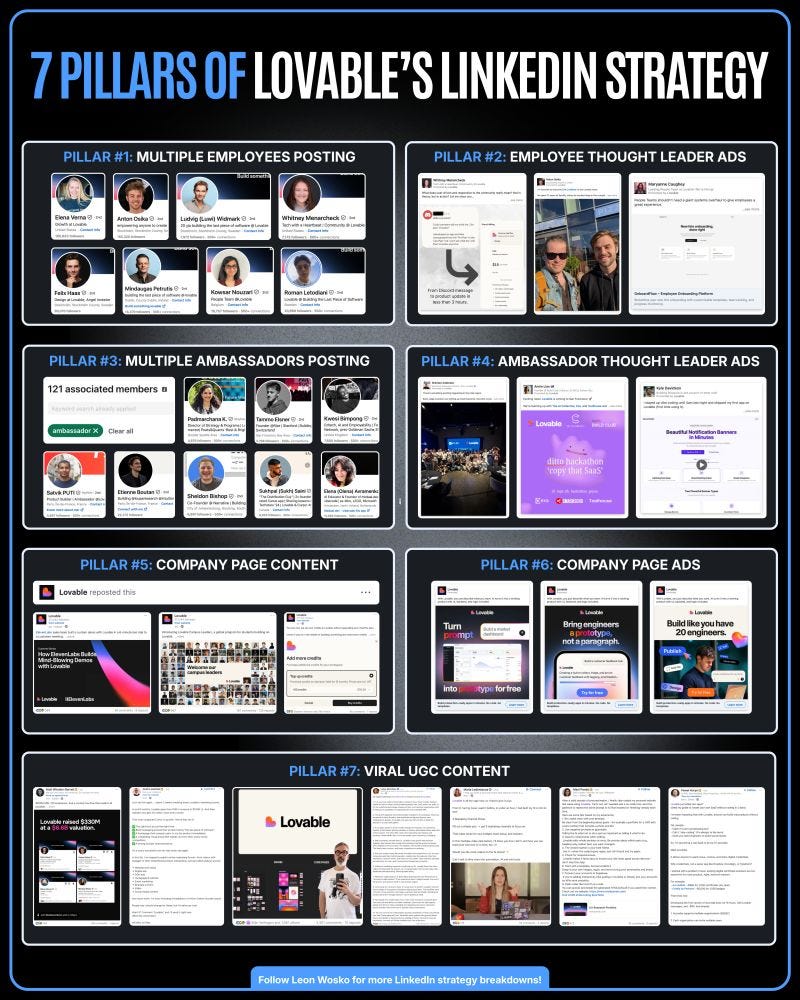
Details on the this playbook in this newsletter: The New Playbook of Social Selling a SaaS through Ecosystem Plays.
04. LinkedIn saturation
What I said: LinkedIn reaches a saturation point. Impressions are already down, bad automation is killing outreach, and the platform becomes more difficult and more expensive.
The evidence:
Reach is down (empirical data). I am constantly reading posts by influencers I follow and discuss in DMs about drops in organic reach. This happens in other platforms as well, and usually the culprit is AI slop and algorithm changes.
LinkedIn CPCs are more expensive. But, CPC inflation has been happening for years, it’s just getting worse, ROI is down, and ads are not easy to justify anymore.
It’s tough.
People are moving to other platforms like Substack from LInkedIn, becoming less active, and less responding to DMs.
Both LinkedIn & Email outreach have become more saturated, and makes it difficult to actually do business because of over-automation.
09. Consolidations and M&As
What I said: a wave of consolidation across SaaS, agencies, and cybersecurity, lasting two to three years, driven by a market that had become too fragmented.
The evidence:
219 cybersecurity M&A transactions in H1 2026 with $9.1 billion in disclosed value, tracking for the highest annual deal count Momentum Cyber has ever recorded.
Across all of tech, Q2 2026 saw 24 companies acquired above $1 billion, the biggest M&A quarter on record at $113 billion.
We (Cyberbit, the company I work at) acquired RangeForce a few months before the prediction, and at the same time I am discussing the agency market with a few friends — agency-owners. If you monitor closely both markets, you will see the activity is increasing.
12: AI companies raising big
What I said: a few big AI companies raise record amounts. Lovable’s $330 million round is just the start, and either Anthropic or Bolt.new raises big money soon.
The evidence:
Anthropic raised $65 billion in Series H at a $965 billion post-money valuation in May 2026.
Lovable itself went from the $330 million round I cited to $400 million at a $13.3 billion valuation, doubling its valuation in seven months (again).
There is also soooo much activity in AI venture rounds and seed funding. But, I expect we see the last around September.
From October and onwards, AI investment will slow down as funds are locked into SpaceX’s huge IPO, a potential Anthropic / OpenAI one and no short-term returns from current investments.
The misses
07. OpenAI acquired or merged by Microsoft
What I said: OpenAI is bleeding money and will need a very big cash infusion. Altman may prefer an investment, but I expect a bid from Microsoft to fully acquire, probably structured as a stock merger when the money runs out.
The evidence:
On 27 February 2026 OpenAI raised $110 billion at a $730 billion pre-money valuation, then expanded it a month later to $122 billion at an $852 billion post-money valuation. OpenAI plans a trillion $ IPO, and seems like it won’t be 2026.
Microsoft holds 26.79% stake. But, it seems like Microsoft is slowly disengaging from OpenAI and focusing on its own CoPilot products alone, as OpenAI looks for new partners.
OpenAI is burning cash, at a rate which it will be out sometime in 2027. Then, it’s either a bailout by the government, new round, or selling itself to a bigger company at a discount.
I still bet on the latter… but you never know!
05. Social listening for SEO and GEO
What I said: social listening becomes a common feature in AIO tools, because brand monitoring is essential for LLM optimisation and citations in social feed into AI answers.
The evidence:
As far as I can tell, this has not happened at any tool. But, the category is so vast…
The idea is with Digital PR and UGC signals being a big part of GEO / AEO, tools will try to support this by adding some tools for broader monitoring, as well as SEO/GEO/AEO being a function under Brand from now on.
This has not materialized.
Btw, someone did a great interview about SEO to GEO, and what actually changed:
08. Rise of EU tech
What I said: as US investors grow wary of domestic risk and saturation, capital flows across the Atlantic. Europe emerges as the stable option, big EU startups get fuelled by US money, and the focus is defence rather than software.
The evidence:
European venture delivered a 27% rebound to EUR 44.1 billion in H1 2026, with seven of the largest venture deals in European history closing inside that period.
Over the same period, European deal count fell to just over 1,740, the lowest half-year total since 2020.
Good money is being invested in the EU, but still the US is keeping up with big budgets. The EU is not catching up, more like playing catch-up and failing badly.
But, I do still believe in the potential of Europe, and that’s why I wrote the: Scaling an EU Business Internationally with Marketing.
That’s essentially my expertise, working from tiny Cyprus in the EU for companies breaking into international and US markets. Currently working for a US company from Europe.
10. Fractionals and freelancers
What I said: layoffs continue, more people adopt the fractional title as long-time full-time employees move to freelancing, and fractional CMOs, CFOs and CTOs are on the rise.
The evidence:
Empirically I see this happening, but it’s not a trend rather than it’s a need: people who were laid off, now running fractional contracts as one of several income lines along with consulting or other gigs.
This prediction came from months following the trend on Google Trends and traffic from one of my articles on Fractional CMOs.
But, it seems that Google Trends is broken… data was distorted.

11. SEO moves under Brand
What I said: SEO is not dying but moves from performance to brand. With attribution disappearing and the work shifting into Digital PR and content, most SEO functions end up reporting into Brand rather than Growth.
The evidence:
Not enough evidence to this happening at all.
Budget is moving toward Digital PR and other brand activities, but an SEO restructuring is not happening.
Still open
06. VC funding away from AI
What I said: more AI investment in the first half of 2026, then a reduction in the second half. Money gets more expensive and funds prefer safer assets over unicorns with unreal valuations.
The evidence:
US venture invested $412.7 billion in H1 2026. 86% went to AI companies.
Most investment went to the biggest AI companies - 94%.
My expectation is that funding will slow down and almost dry by Q4. Whatever AI companies have raised for now, that’s it.
The next investments will require proof of profitability and future growth. They will not be “free” and so “hyped”.
Next evaluation on December
Many things can change until the end of the year.
Everything is moving SO fast, it feels like an EON of experience.
Do you agree with my takeaways?
I would love to know your opinions, predictions, and expectations of the last few months of 2026.
Let’s start a conversation :)
P.S.: Yes, it’s August and you might be on vacation. I am too… but growing my social presence.
If you enjoyed this newsletter, support me by subscribing and sharing with your friends & colleagues.