
Google Trends is Broken, Why does it Matter?

Everything is trending. That’s the problem.
Google Trends is showing near-vertical spikes to 100 for terms that have no business moving.
I tested 31 keywords around topics I knew pretty well and added some always-relevant high-volume queries as well.
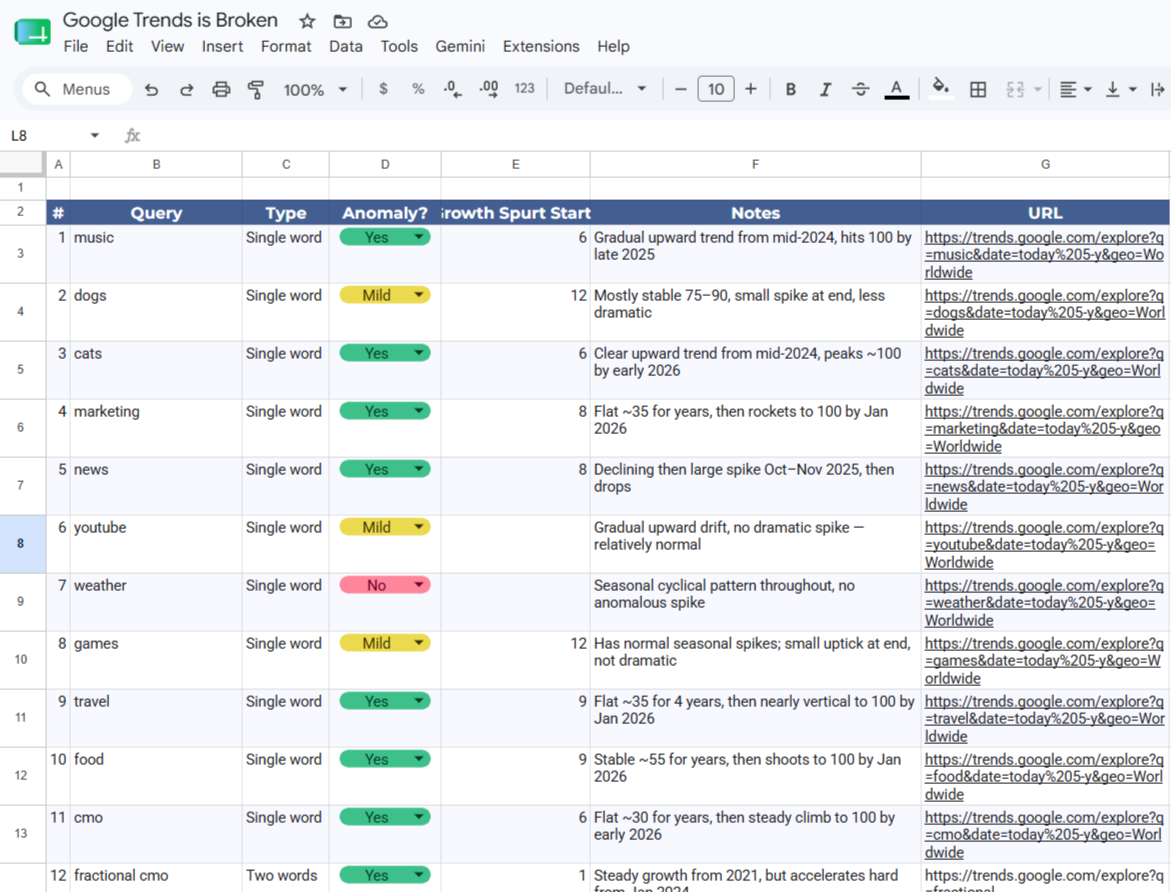
This is happening in the same year that human searches per user fell nearly 20% and AI Overviews are being expanded to cover the whole world.
Three Waves, The Timing
The anomalies do not all start at the same time. They arrive in three waves across 2025, and each wave lines up with a Google AI release.
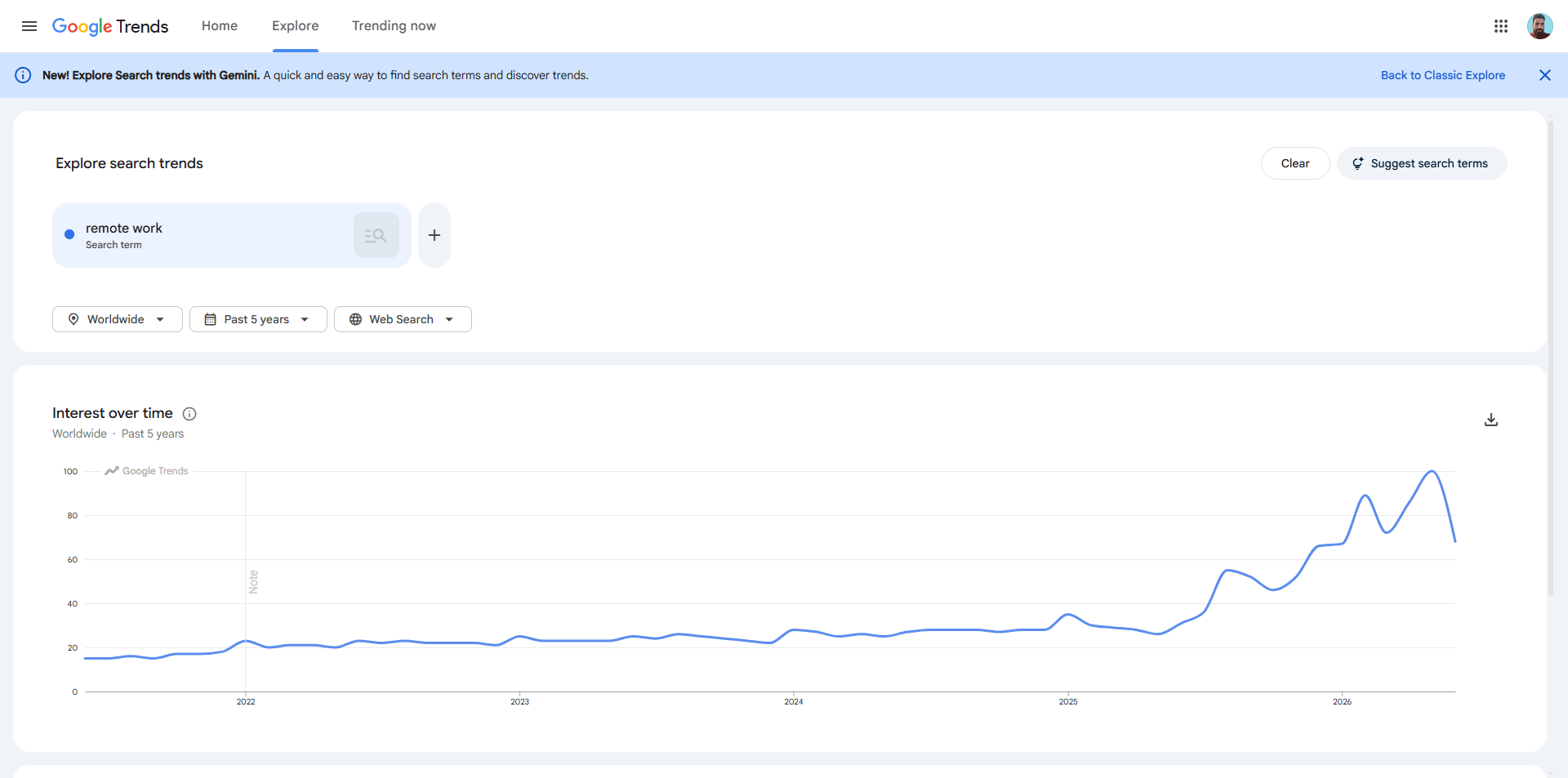
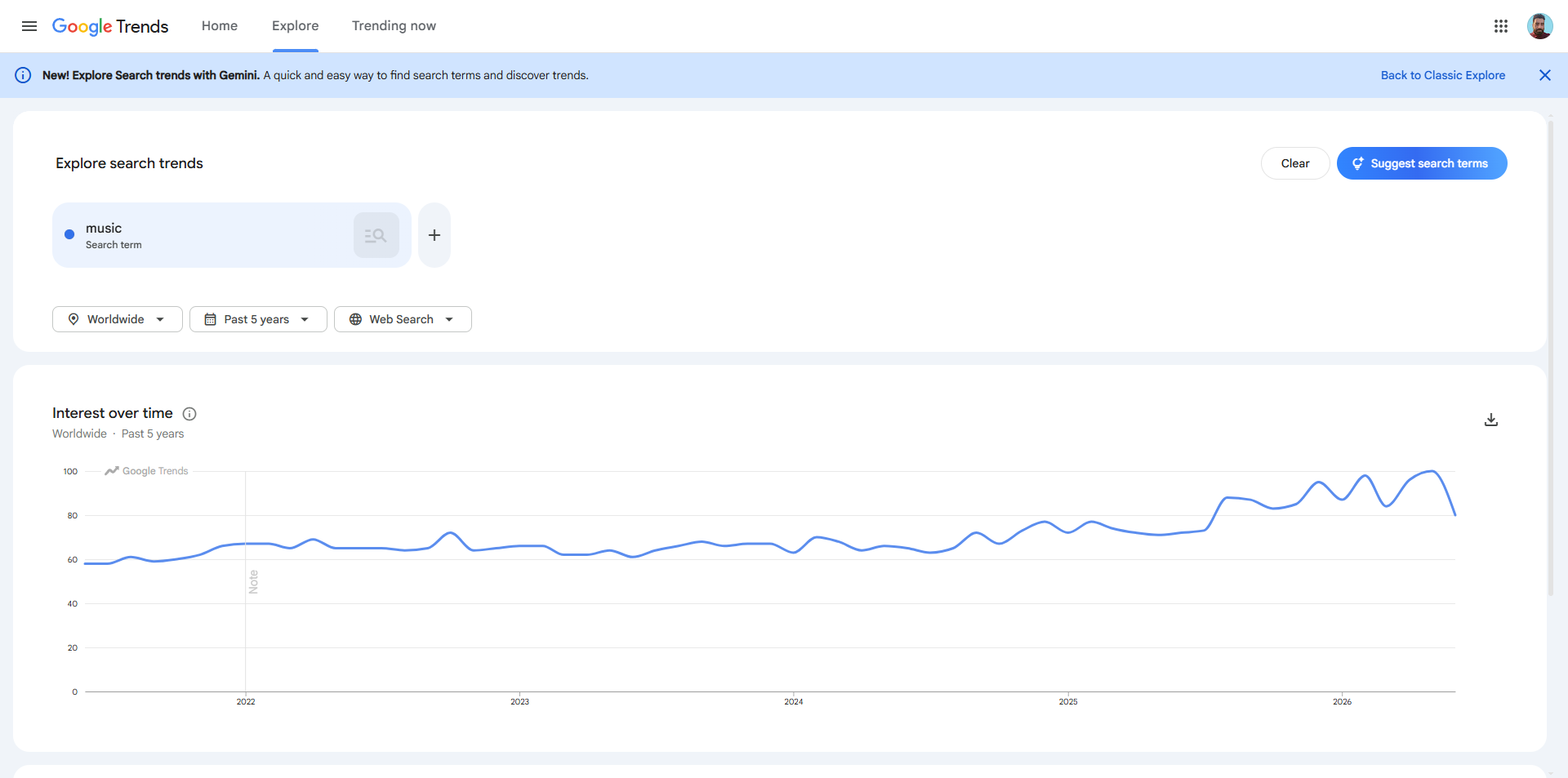
Wave one, around June 2025. Music, cmo, remote work, AI tools, digital marketing strategy, fractional cmo services. This lands one month after Google I/O, where AI Mode launched in the US using a technique Google calls query fan-out. One question gets broken into subtopics and fired off as a batch of separate searches.
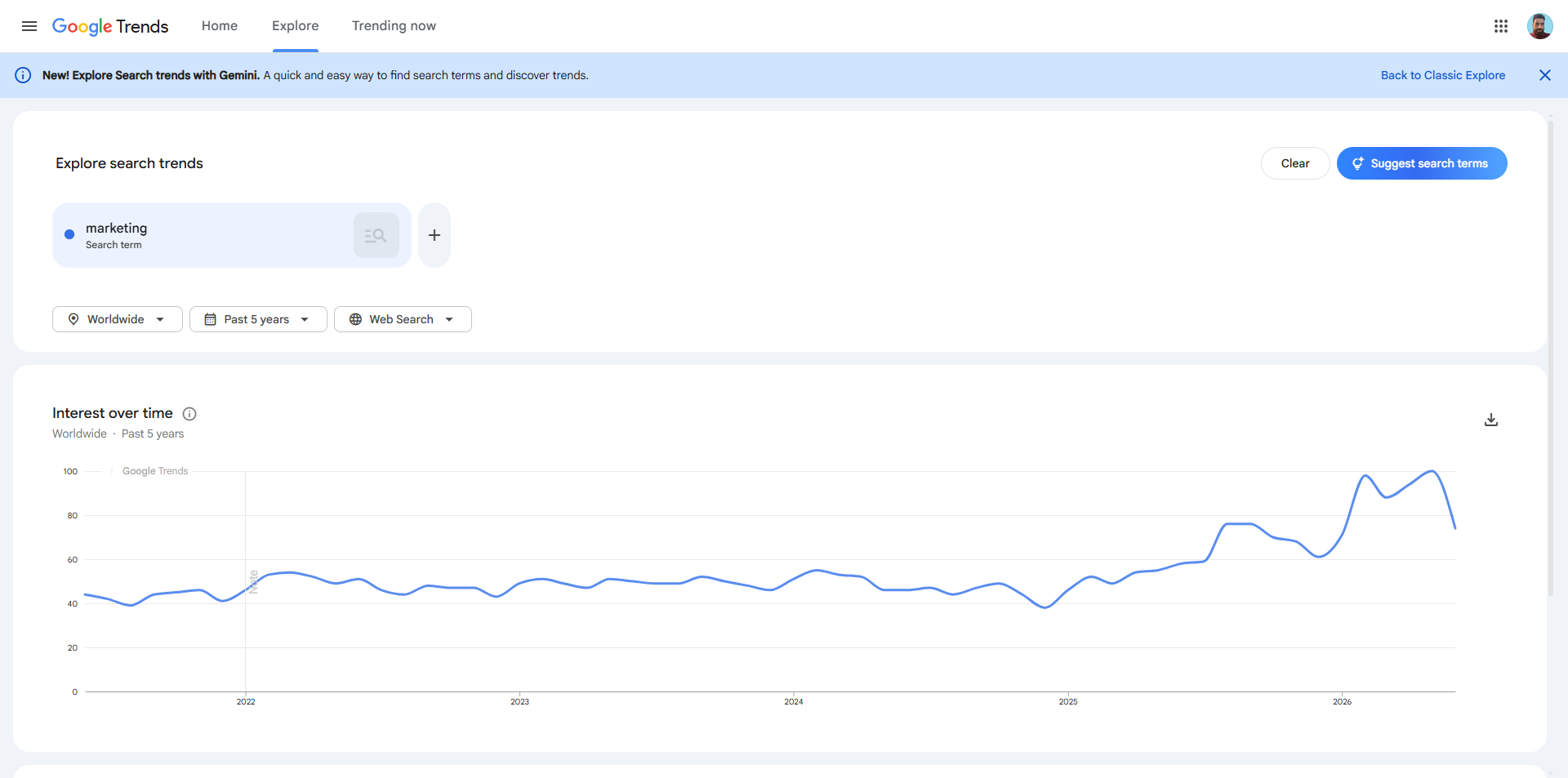
Wave two, around August and September 2025. Marketing, social media, travel, food, artificial intelligence. This is when AI Mode went global, and when Google removed the num=100 parameter on September 11, stripping a wave of bot impressions out of Search Console overnight.
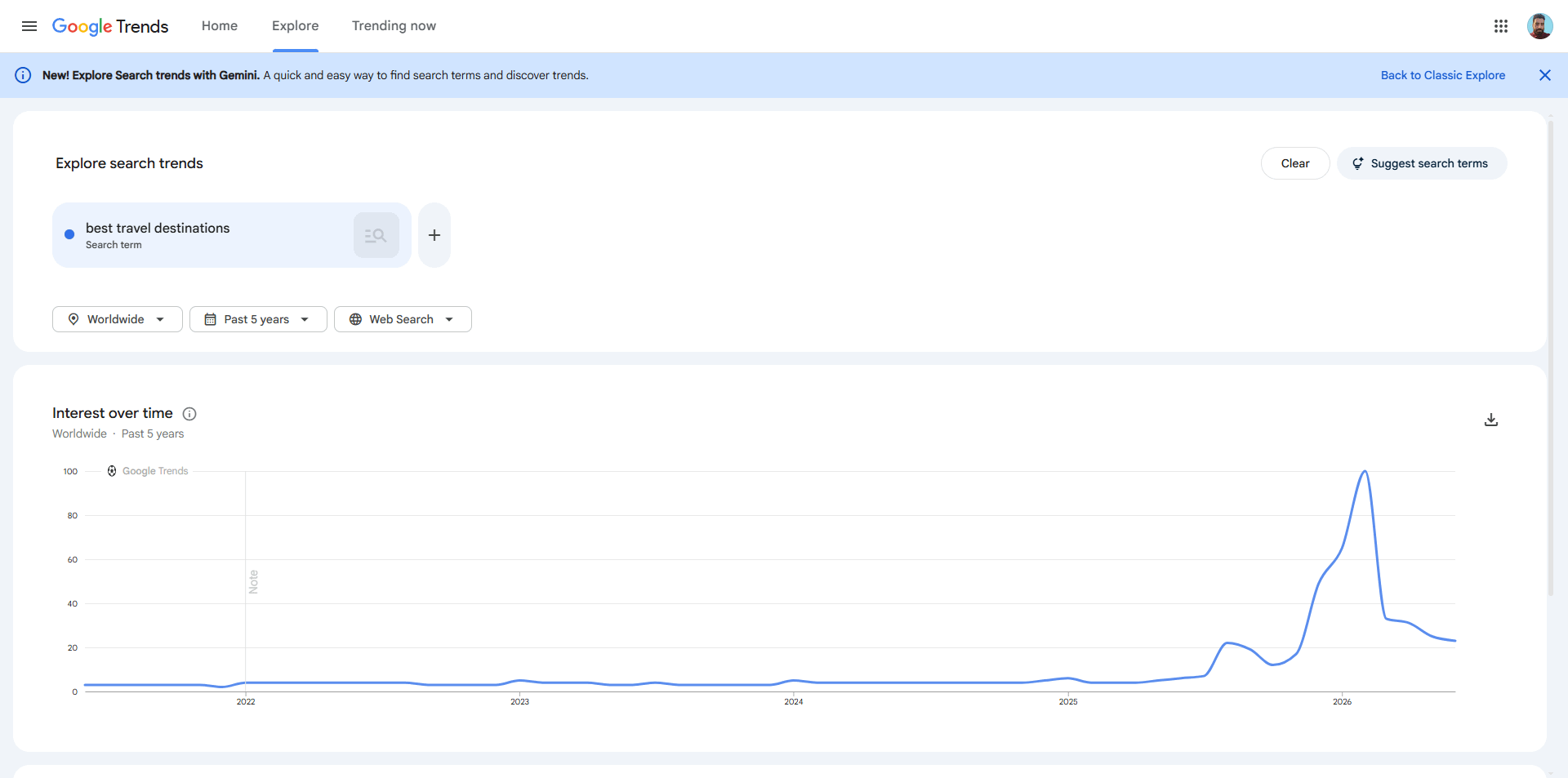
Wave three, October to December 2025, peaking January 2026. Electric car, how to invest, best travel destinations, work from home. AI Mode reaches 180+ countries, Gemini 3 Flash becomes the default model, and then Gemini gets embedded directly into the Trends Explore page.
Now the mechanism. When an AI answers one question, it fires off a batch of background searches to Google to assemble the answer.
A single human question becomes many machine queries.
If Trends is sampling from that pool, it has stopped measuring human curiosity.
Huge disclaimer here, while it matches some Google events, it may come from other AI tools, crawlers, or misconfigurations hitting Google searches. We are not certain what causes this, and there has not been any public acknowledgment around this.
The Proof
I first noticed Fractional CMOs are trending, this is a topic I have been following, because I wrote an article and worked as a Fractional Head of Marketing for a couple SaaS.
Similar trends were showing up for Fractional CROs, and Fractional CFOs.
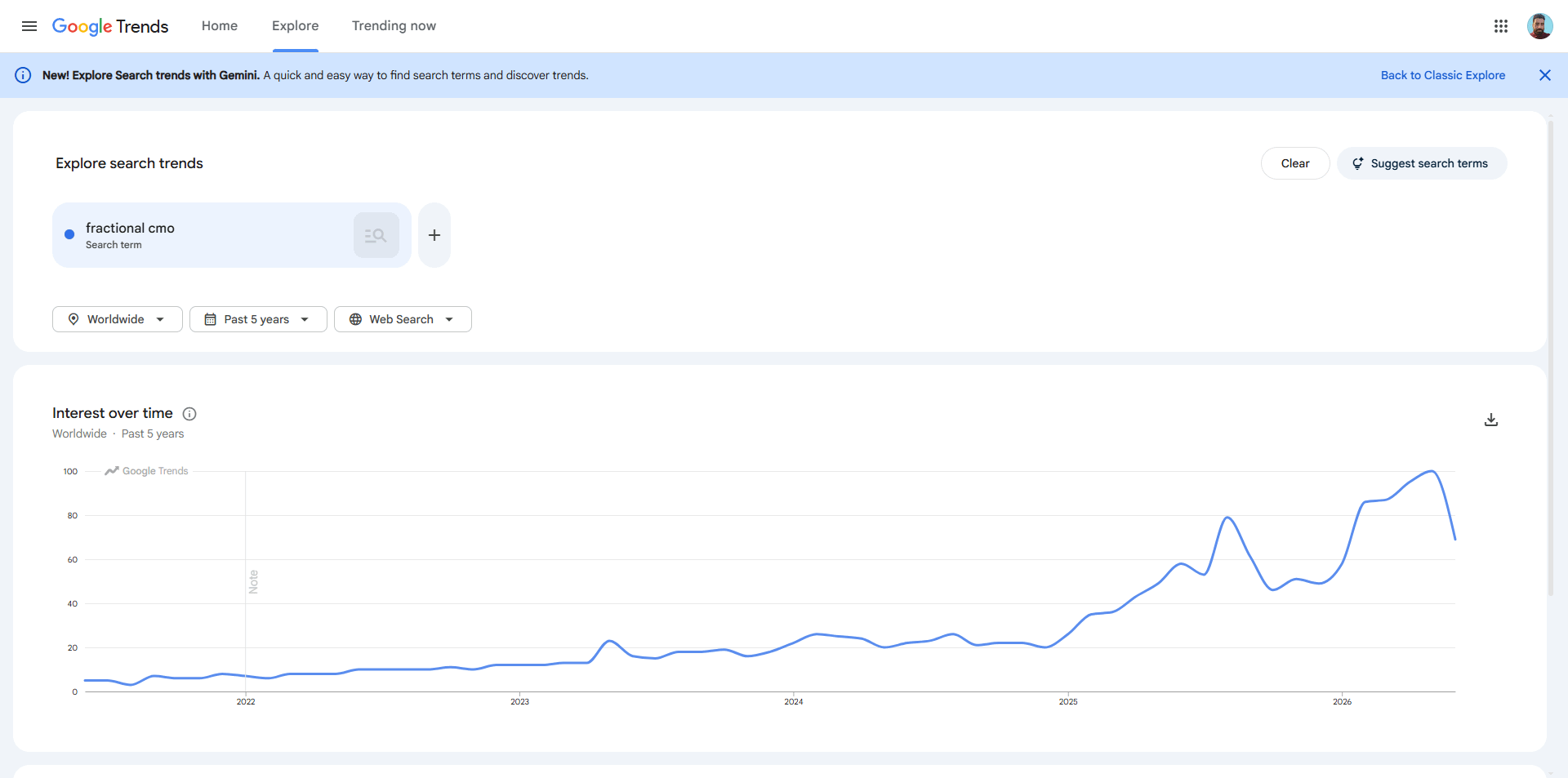
Google Trends shows “fractional cmo” on a steady climb to an all-time high. Here is what my actual Search Console says for the exact same query, same period.
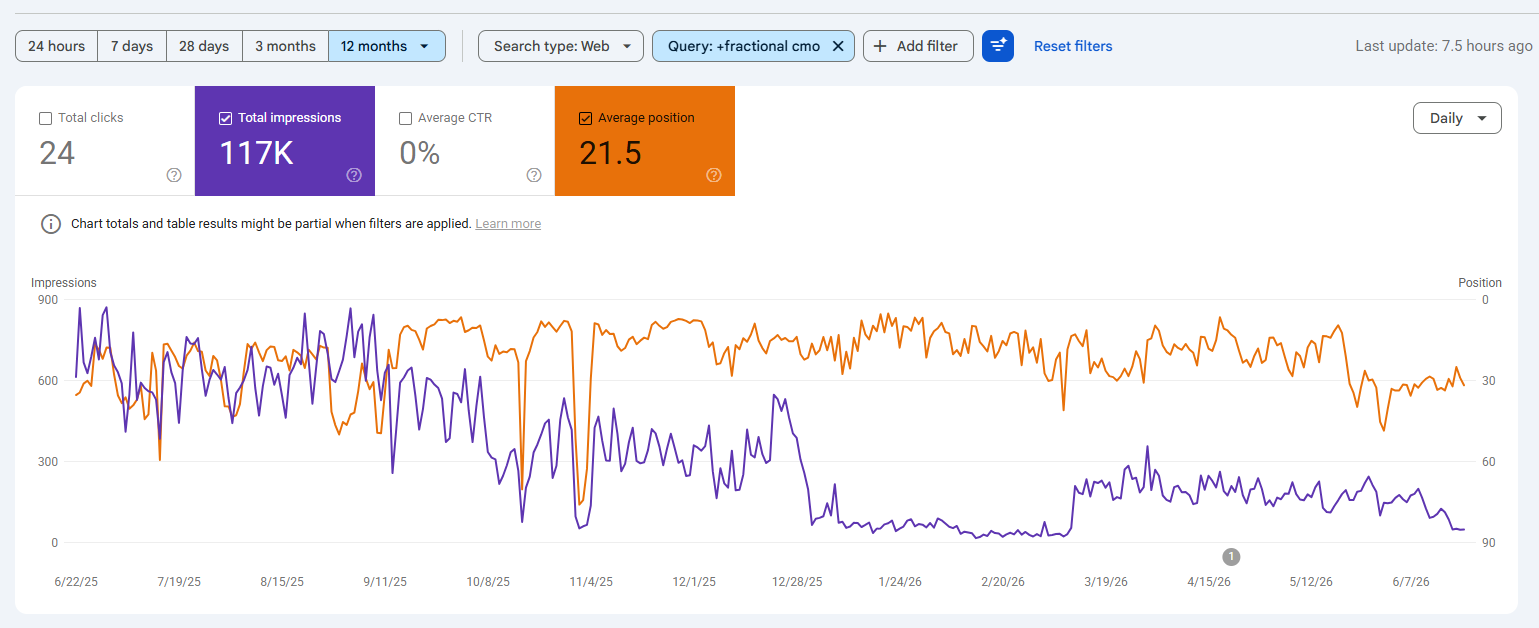
An average position of 21.5 that barely moves most of the year. And the impressions do the opposite of the Trends line.
They run high through mid-2025, fall off a cliff in the fourth quarter, sit on the floor through January and February 2026, and only partly recover in spring.
The Trends Graph does not agree with the Google Search Console data.
Why is that?
Either the demand was never as real as the Trends line implies, or Google cleaned the bot traffic out of Search Console and left it inside Trends. Neither version is good for anyone making a content bet off that 100.
This is worst for B2B, because Trends is noisiest for low-volume terms, and low volume is where B2B lives. Semrush’s own guide shows a term like “fractional content team” peaking in Trends on 10 monthly searches.
Online Chatter on the Topic
I am not the only one seeing this. James Finlayson, Head of SEO at MPB, started a conversation a couple weeks earlier. Mature categories like air fryers, car insurance and London hotels are all at all-time highs that bear no relation to reality.
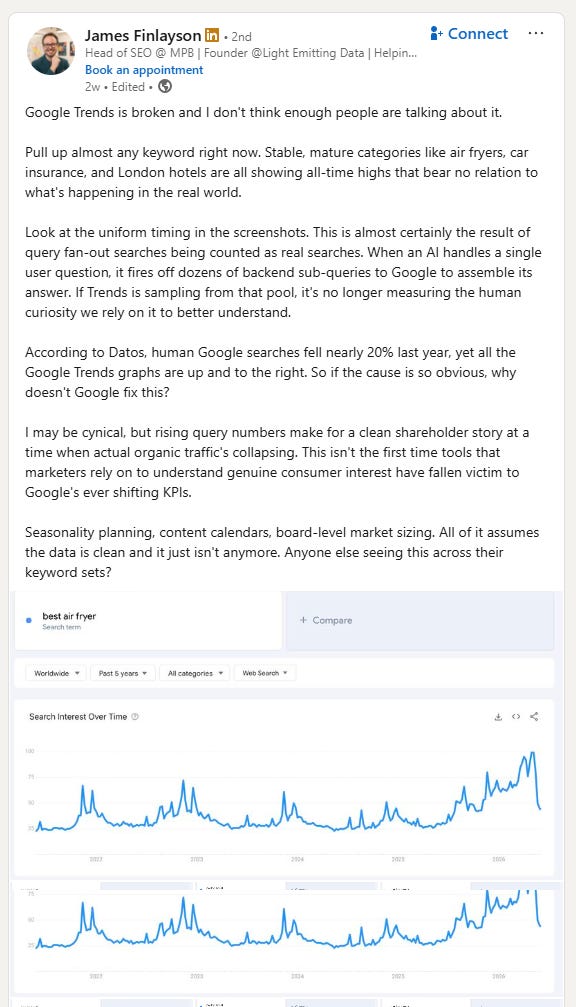
The thread underneath is a who’s-who landing on the same conclusion.
Joshua Squires at Amsive and Peter Jaffray both point at fan-out and LLM trackers, with Jaffray noting Trends climbs while human sessions in GA4 flatten.
Lily Grozeva sees the same distortion in her own Search Console and traces it to AI bots from her Rankscale projects.
Malte Landwehr, CPO at Peec AI, posted the same week that the most common fan-out terms all spike in Trends.
Daniel Pokorny reframes the whole thing. Search data used to be a proxy for human curiosity. Now AI generates the queries on our behalf, so are we measuring people or machines.
Then the honest counterpoint, because it matters. Chris Byrne and Natalie Le both cite Google’s own documentation, which says searches made by AI Mode and AI Overviews are filtered out of Trends.
So if anything is leaking in, it is the other LLMs grounding their answers on Google, the GEO trackers, and the scrapers.
Or, Google’s filter is not holding.
Either way, the clean “Gemini broke Trends” story is wrong, and the real one is messier and more interesting.
Why it Matters: Trends Became a Feedback Loop
Separate the two problems. The data problem started mid-2025. Gemini only entered the Trends interface in January 2026. So Gemini-in-Trends did not cause the spikes. What it does is make the loop worse.
Trends is no longer a passive chart. With Gemini on top, the platform now interprets the data for you and tells you what is “emerging”.
Here is the process:
The AI flags a breakout.
Content teams chase it.
More content gets published.
The signal looks validated.
If the original spike was noise, you have spent pipeline and budget against phantom demand, and then manufactured the very trend you thought you spotted.
What to do Instead: Triangulate
Validating every spike against absolute volume and first-party data before it touches your calendar.
Use first party data to provide trends (if possible), else, use more tools.
My tool recommendations:
Ahrefs or Semrush to pair trend direction with real volume, keyword difficulty and SERP competition. Combine the data you see with their own tools, where work to decouple traffic from multiple sources to the keyword level. But, much of the data is not grounded in reality, it’s just another touch point.
Exploding Topics for genuine discovery, organized by sector including SaaS, using analyst review instead of a relative index. It combines data from multiple sources including social media trends to provide trends to what’s happening.
Brandwatch for social listening across millions of sources, with Talkwalker or Brand24 as cheaper entries.
Then cross-check anything interesting against your own Search Console and CRM. Your first-party data is the one source the machines are not inflating for you.
A Few More Examples
I first thought Fractional CMO was trending, and I updated my article dating from 2023 on the topic. This did not work as well as expected, I lost little time… but I started thinking, what if I did the same for 10, 20, or 30 pieces?
That’s actual time & cost sunk into trusting a tool that is broken.
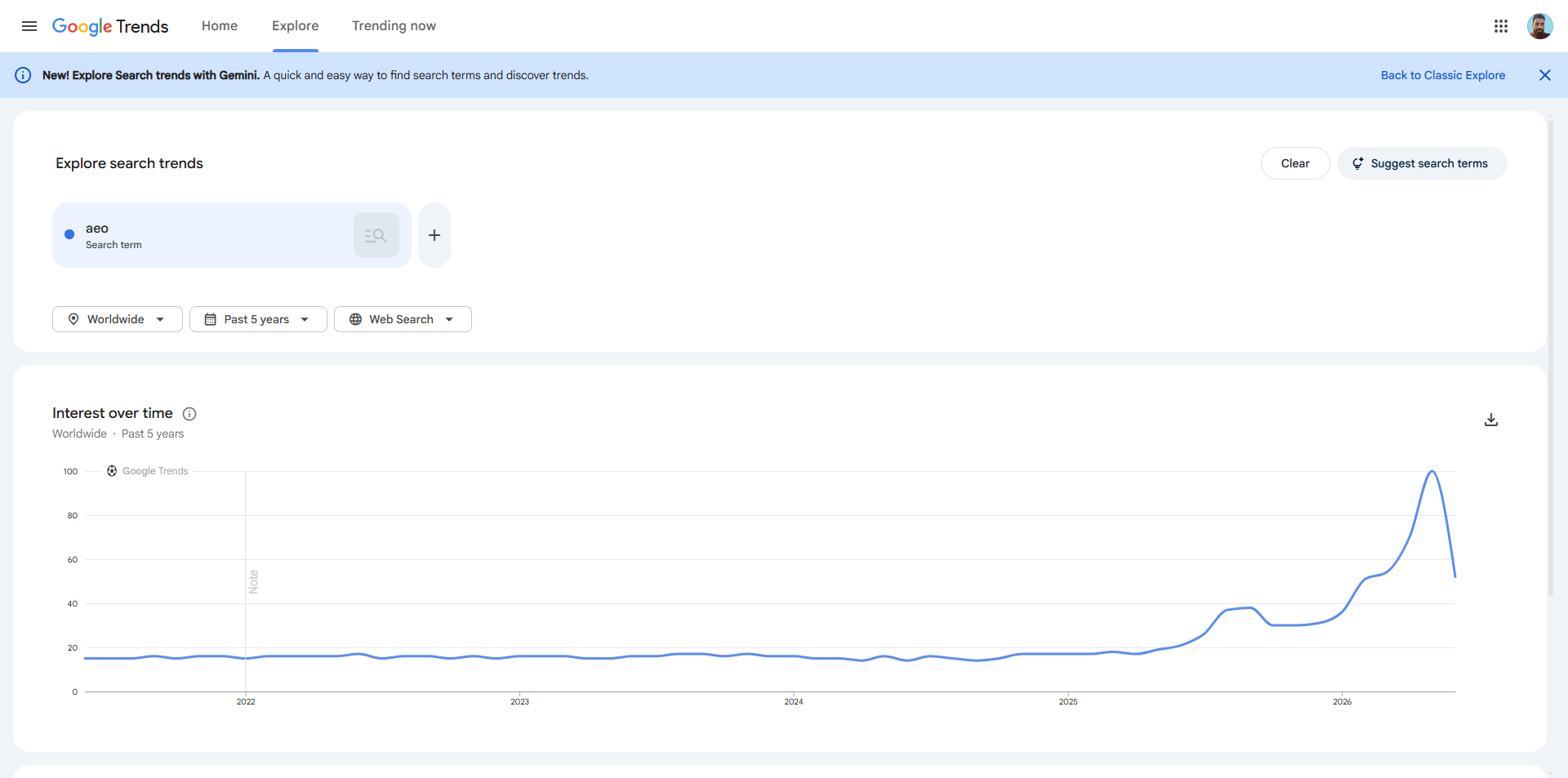
Here are a few more charts going haywire because of query fan-outs, LLMs, and bots…
One thing I've noticed is that people often mistake Google Trends for a measure of demand.
In reality, it's a measure of search behavior.
Those aren't always the same.
Some of the strongest buying intent never shows up as a spike because the buyer already knows what they want. Meanwhile, curiosity can create huge search volume with very little commercial intent.
Search data is incredibly useful—but only when it's interpreted alongside buyer psychology, not as a proxy for it.