
Your Newsletter Is Not a Nurture Sequence - Here's One

Most B2B SaaS companies don’t nurture their leads.
They send updates and call it nurturing.
It’s a start, but not your end-goal.
And the difference shows up in pipeline.
In this section, we will go through an example sequence and how it can help you start actually nurturing leads into clients.
Updates vs nurturing
A monthly update is a one-to-many announcement.
It helps engage and stay top-of-mind, but it’s not enough to move the sales cycle quickly enough.
A nurture sequence is lifecycle-aware.
It branches on
what the contact did,
when they did it, and
what stage they’re in.
A contact that downloaded a gated report last week is in a different conversation than a contact that requested a demo two months ago and went silent.
What an Actual Nurture Sequence Looks Like
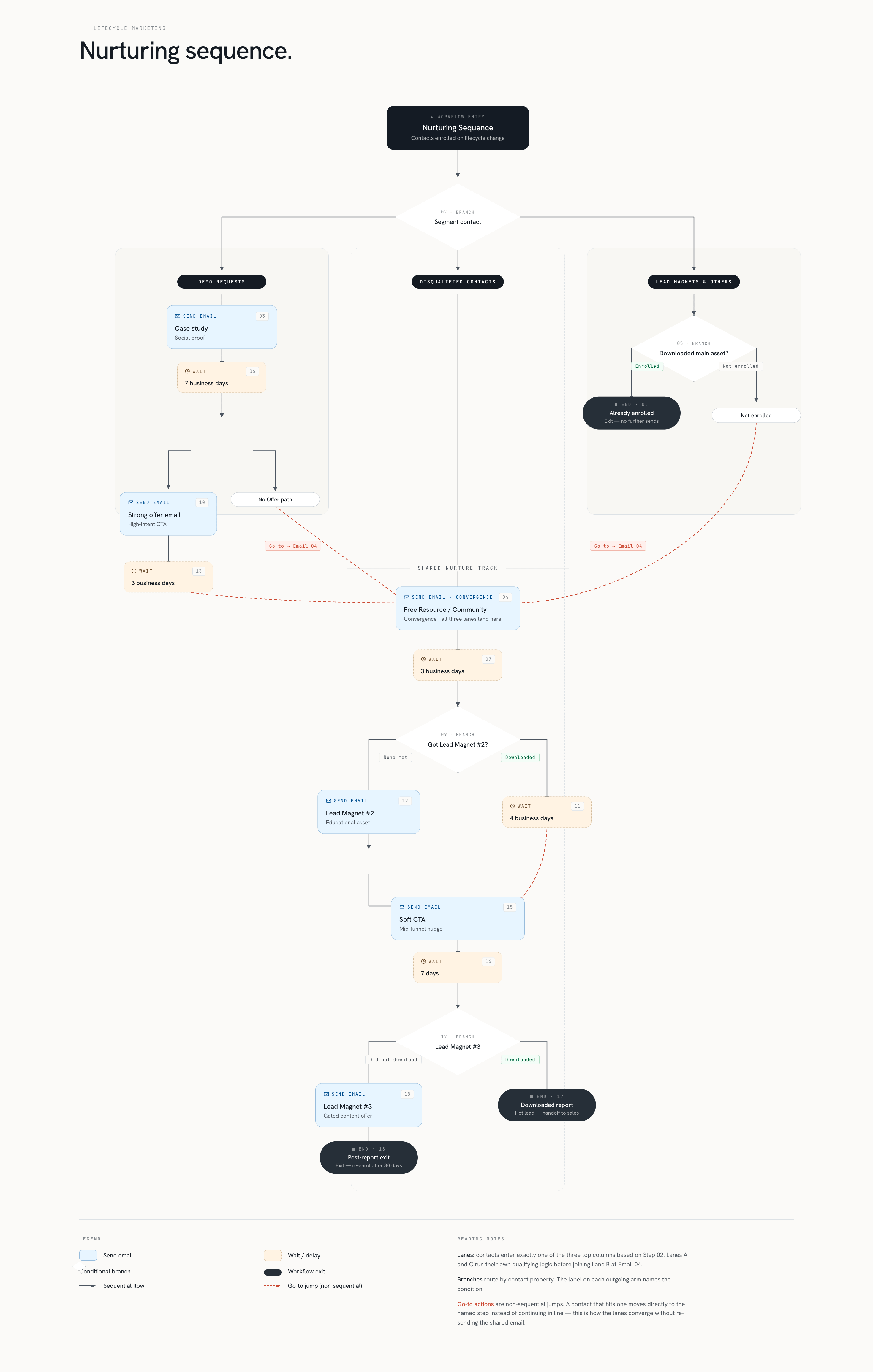
(diagram above)
This is an example nurturing, I have done before. You can copy it, but consider it more like a guideline to better understand your options rather than a strict “perfect” model.
A few things to discuss about:
Three entry lanes, based on how the contact joined the list. Demo requests get one motion. Disqualified contacts (people who showed intent but are not ICP-fit) get another. Lead magnet downloads and general subscribers get a third.
Each lane has its own qualifying logic before it converges. The demo request lane sends a case study, waits 7 days, then checks if the contact is eligible for a an offer. The lead magnet lane checks whether the contact already downloaded the main asset, because there’s no point sending it again.
A shared track picks everyone up. After lane-specific work, all three columns converge at a free resource / community email. From there the branching continues on actual contact behaviour. Did they download Lead Magnet #2? Did they download the gated report at the end?
Two exits. A cold exit, with re-enrol after 30 days for contacts that never converted. A hot exit, with handoff to sales the moment they download the gated report.
This sequence does two jobs.
It nurtures existing demo requests back into conversation.
It moves cold leads into new demos.
Important Checks
The hardest part of nurturing is to be mindful of leads, stages, and conversations happening. For example, sales often does not like marketing sending too many emails to their hot leads.
A real nurturing sequence has to know:
Is this contact a current customer? If yes, don’t send them prospecting content.
Are they currently in a sales conversation? If yes, drop the sequence. Sales owns the relationship now.
Did they book a demo since they entered the sequence? Stop the sequence.
Are they an active opportunity in CRM? Pause until the opportunity closes (won or lost).
Own the Channel, Own the Communication
By owning the lead’s email you have undisrupted access to their inbox. You have to use it without abusing it to get them to buy.
A nurturing sequence does a lot of heavy lifting, and it’s difficult work.
It also requires ownership, auditing often, and checking whether it’s working or not.
A few more pointers to keep email comms working well:
Lifecycle stage hygiene. Half the CRMs I’ve audited don’t have clean lifecycle stages or correct notes. A clean CRM, updated stages, and removing dead leads is important.
Segmentation discipline. “Demo request” and “lead magnets” should be different entries. Understand how to treat different people, without ignoring them. Your cold lead today may be a future client in 2-3 years.
Marketing-sales handoff. When sales takes a lead into a deal, marketing should know. Most companies don’t have this loop running, so sequences keep firing into active deals, this kills the marketing <> sales relationship.
Ownership. Clear ownership of a CRM / Email manager is important. This is a responsibility and needs to be re-visited often!
So teams default to the safe option.
A monthly newsletter goes out to everyone.
I love newsletters, it’s your first step.
But, never stop at the first step, no one won a marathon with just one step. You need to go the full way!
A Final Note
A monthly newsletter is a fine baseline.
I’ve written before about why email is the channel you actually own, and that hasn’t changed. Owning the inbox is the right way to go.
But owning the inbox is not the same as nurturing the contact.
A newsletter going to everyone is a brand signal.
A sequence branching on contact state is a pipeline signal.
If your team is sending one thing to everyone, you have brand.
If your team is building nurturing into the pipeline, you got an accelerated pipeline with more ARR coming up faster.