

The biggest mistake new growth marketers make is reviewing and strategizing for over a month.
Your first 90 days at a company are the most important window to establish political capital by showing early results.
Companies hiring for a Growth Lead expect results… FAST.
Joining a company you have about 90 days of goodwill.
After that, every initiative gets questioned, every budget request gets pushback, every “let’s test this” turns into multiple stakeholder meetings.
Quick wins aren’t just about hitting numbers fast. They’re about earning the right to do the bigger, slower, more strategic work later.
This is the playbook I use:
2 weeks of diagnosis.
10 weeks of activation.
Then the real work begins!
B2B Marketing Shots is a weekly no-BS newsletter from a marketer to a marketer.
Every week, I share…
lessons,
ideas,
templates,
tools, or
interviews with other marketers.
Subscribers get fresh content for free, but older content and templates are locked only for paid subscribers.
If you get a free trial, you will unlock all content for 30 days.
But, most importantly, you will support me to continue writing and developing better templates and tools for marketers to use in their everyday work.
For 5 euro per month, ~$5.7 you get full access!
Why quick wins earn political capital
Big projects, rebrands, martech overhauls, ABX motions are very long projects with a long-term ROI.
Many marketing leaders join a company and immediately start a rebrand project. That’s often a big mistake.
Credibility is a currency in any company. Any marketing leader needs to build credibility through quick wins before tackling on long-term, budget-heavy projects.
Let me tell you a secret:
Quick wins are often boring.
It’s often about asset activation, clean-ups, and discovering sidelined opportunities.
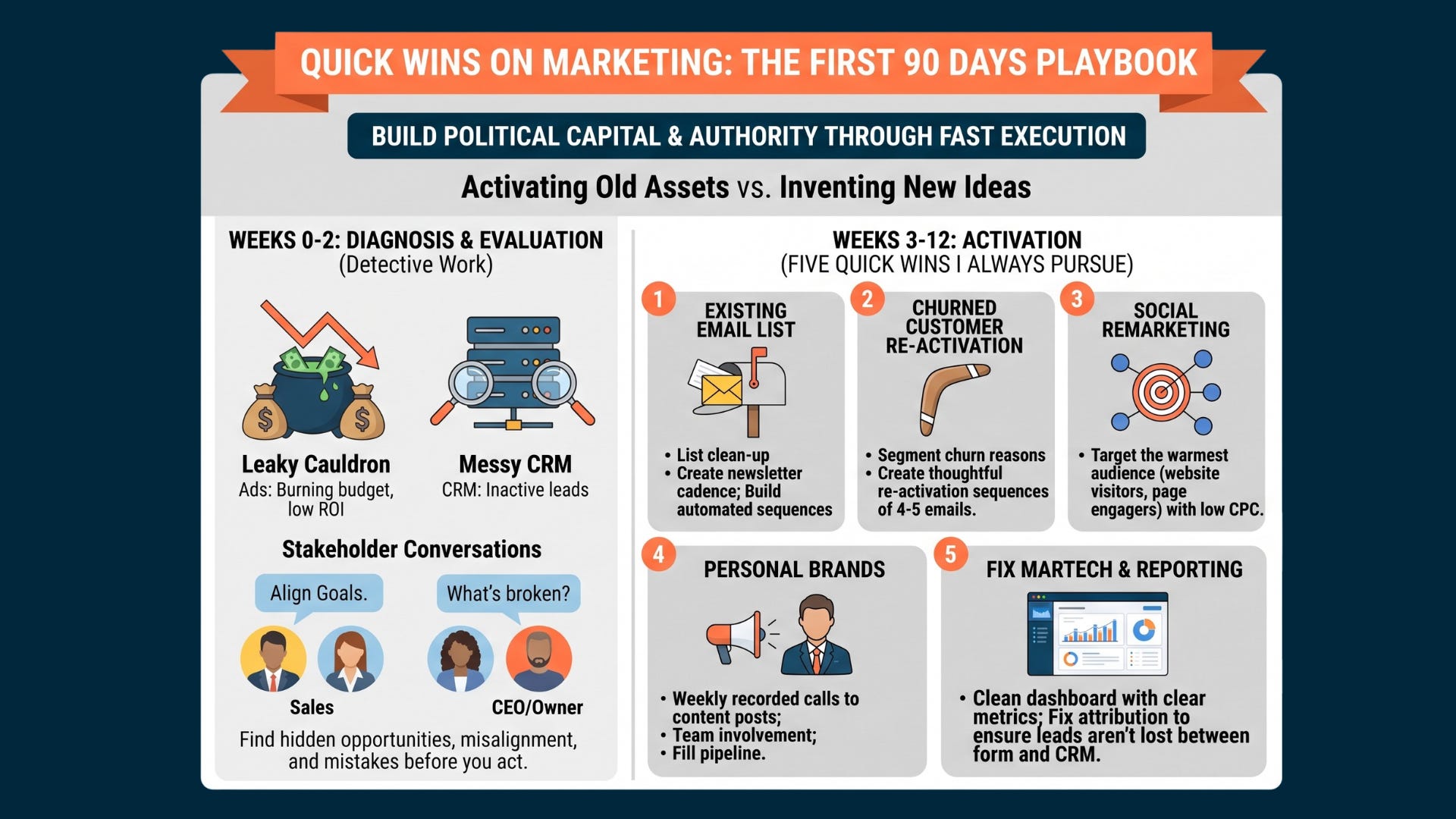
Step 0: the first weeks - Εvaluation
The first 2-4 weeks are detective work. You’re piecing together what’s working, what isn’t, and why nobody’s mentioned it.
Then act fast. Speed of execution matters more in your first quarter than at any other point in the role.
If you are working with a founder / owner directly, their patience is incredibly thin. You don’t want to lose them.
Before you touch anything, you diagnose. Listening, pulling data, and building a map of where the leaks are.
Ads - The Leaky Cauldron
Every active campaign across Google, LinkedIn, and Meta. What’s spending, what’s converting, what’s been running untouched for six months.
Look for:
broad match burning budget,
outdated creatives,
Mistargeted audiences,
overbidding on brand,
ads with bad ROI/ROAS…
Tech Stack Review - CRM & Email
The most important part of the business is the data you own.
What leads are there.
Are they active - e.g. are they opening the emails?
How is the pipeline moving?
Do you have an email cadence + newsletter? If not, why?
Many companies benefit enormously from fixing their CRM, cleaning up the list, and starting to communicate.
Stakeholder conversations - Sales, CSM, Product and more
Marketing has to have a direct line to other departments. Talk often with Sales: the AEs, CRO, the SDRs. They’re your eyes and ears on the ground.
CSM & Product are important for internal feedback as well, and possibly your allies in implementing campaigns.
And don’t forget to pull as much knowledge as possible from the CEO/owner, be sure to also clarify the goals with them:
What’s working that you wish we did more of?
What’s broken that nobody’s talking about?
If we moved one number in the next quarter, which one matters most?
What you’re actually hunting for are three things.
Hidden opportunities like assets, audiences, or motions nobody’s looking at.
Misalignment. Sales thinks the issue is lead quality. Marketing thinks it’s follow-up. The CEO may think something else entirely.
Mistakes like the campaign talking about features that no longer exist, or that no one cares about.
The diagnosis is the work. Everything after is just execution.
Five Quick Wins I Always Pursue
Each company is unique, and may require a different approach.
Focus on the domains where you have the most expertise. That’s where you’ll deliver the strongest, most ROI-positive solutions.
Here are the five places I look first.
1. The existing email list
Almost every B2B company has a list. Almost no B2B company emails consistently.
Most lists I inherit haven’t been emailed in 60 to 180 days.
Some never properly.
Deliverability might require work.
What can you do?
Send out a first announcement
Clean the email list
Create a newsletter cadence & topics
Build some automated sequences - onboarding, offboarding, upsell, lead magnet CTAs, educational sequences.
You have an asset worth many $ built over time. It’s a shame not to use it!
2. Churned customer re-activation
Churned customers are a treasure trove.
Many churned customers on SaaS or B2B services leave because they are looking for something new, are missing a feature, or get poached.
Many end up returning because they were not happy with the alternative.
Often, your competition’s promise was empty, and you can win some back.
Pull every churn from the last 18 to 24 months (or longer if it makes sense).
Segment by reason:
price,
fit,
timing,
missing feature.
Then cross-reference against the product roadmap.
What shipped since they left?
What changed that would change their answer?
If you don’t have enough data, just write one thoughtful email covering everything that’s changed in the past two years:
New features,
New positioning,
New pricing,
New needs,
New market conditions.
Prepare a re-activation sequence.
Acknowledge what has changed, give value first, then introduce the changes in the product/pricing.
Then, pitch a re-connection with a CTA.
Don’t email just once. Keep the sequence 4-5 emails long at least.
You will see your AEs pipeline filling up just from this activity.
3. Social remarketing, don’t miss the warmest audience
Every B2B company with a pixel has remarketing audiences.
Most have barely used them.
Pull the audiences in week three.
Website visitors.
Video viewers.
Page engagers.
Lookalikes of converted accounts.
Most of them have been sitting in the ad platforms for months, populated by organic traffic, accumulating quietly.
That is your warmest audience.
They have already visited your website.
They already know the company / product.
Remarketing (or retargeting) is one of your lowest-CPC audiences, and they’re ready for the next step in the funnel.
Bonus tip #1: Retarget the LinkedIn followers of your company’s page. No need for a pixel to collect visitors.
Bonus tip #2: Use Meta’s lookalike audience to build a list based on those. It’s often better than targeting widely with demographics. Start with what the platform knows about your existing audience.
4. Personal Brands
This is the slowest of the five, but activates the audience to come looking for a demo.
It also compounds the most.
Many B2B CEOs, especially founder-CEOs have the authority, the following, and the market relevance.
Convince them to start posting.
Convince the rest of the team to post / repost as well.
How do you make your busiest person post on social like LinkedIn? Follow the steps below:
30-minutes recorded call every week
Use the transcription to write 5 posts / week (or more)
Set-up reminders on their calendar at a specific time with each post. Use Slack automations to remind them also there.
Share the post in the “General” slack channel to keep the team engaged.
Share variations of the posts for AEs, CSMs, and Engineers to post (ok, engineers won’t post easily)
Your company leader is the loudest advocate, with the strongest voice in the company.
Depending on the type of company, the most valuable employees might be: engineers, designers, writers, managers, or other SMEs.
Many of your employees are well-connected to the industry and can be your assets.
Consider this: Prospect asks the founder/employee about the product → founder/employee passes the prospect to Sales.
It’s not as simple or smooth, but works to bring in pipeline hanging around and being unaware of your offering!
5. Fix the MarTech & Reporting
Honestly, maybe your biggest win is to fix the reporting. Many leads may have come from channels owned by marketing but are misattributed.
Keeping a clear, easy-to-read dashboard for the executives & board is essential.
After that, I would figure out whether everything else works.
You can’t imagine how many leads get lost between a marketing form and the CRM, then sit untouched by Sales.
Many qualified leads are not always followed. It’s not always anyone’s fault. Sometimes:
People leave
People get fired
Miscommunication
Changing priorities
Things happen, important items slip below the radar all the time.
I am planning to share a few reporting templates, only for paid users in the next few weeks.
You can get a free trial to access those templates, and comment below if you would really like reporting templates for B2B & SaaS marketing.
The Winning Pattern
Every quick win on this list shares three properties.
It activates an asset the company already owns.
List,
churn data,
product changes,
ad audiences,
employee reach.
It requires zero new budget.
Which means zero new approvals.
You are optimizing an existing asset or an already-approved budget line. No dependencies (I love this).
And it produces a number you can show in a slide. Open rates. Reactivated MRR. Feature adoption. CPL delta. Pipeline.
The trap most growth managers fall into is trying to invent growth in the first 90 days.
Inventing is expensive, slow, and politically risky.
Activating is cheap, fast, and earns you the room to invent later.
Your first 90 days isn’t about new ideas.
It’s about new attention to old assets.
After the First 90 Days
All that political capital buys you authority for long-term projects.
ABX campaigns (that take months).
Event planning, booth preparation.
Branding and positioning projects.
Sales & marketing alignment (that takes time as well).
This is slow, unglamorous work. It looks like documents and workshops and hours of arguing about definitions in rooms that feel like they’re going nowhere.
But it’s the foundation.
You cannot build a growth engine on top of four teams running four definitions of the same number. Alignment is the prerequisite to scale.
Quick wins aren’t the strategy.
They’re the permission slip for the work that is.