
Collecting Reviews from Corporate Clients + A Template to Help

Review sites are becoming more important. They are creating the “trust layer” between search, AI, and humans. Reviews and lists on sites like G2, Capterra, Gartner etc. help visibility and attracting net new eyeballs on your product and services.
Established review platforms screen their reviews and are quite trusted by both people who still visit them and LLMs training on their data to provide answers to your customers.
I have run review projects in two B2B SaaS now, utilizing a support or CSM team to collect the reviews.
High-touch, white-glove B2B companies with a low number of users but strong relationships have to use semi-manual methods to collect reviews.
Let’s go through on the process & some tips :)
Get Your Profile Updated
Buyers self-educate through most of the funnel, the buying committee uses top X lists to prepare their short list (if they don’t already have a solution in mind).
You probably want to start with sites like:
G2,
Capterra,
TrustRadius, or
Clutch for agencies
G2 recently acquired Acquire Capterra, Software Advice, and GetApp from Gartner. Making it one of the biggest consolidation in the market.
Avoid TrustPIlot
Keep away from TrustPilot, I have terrible experiences with SaaS users blackmailing companies using reviews. IT does not review or remove any review for any reason. It’s a place where black hat marketers use to manipulate reviews, hurt competitors, and bad actors run wild.
Your Profile
Be sure to create your profile or take-over your existing profile. In most platforms, you may need to prove your ownership, talk with an account executive and work your way through some burreacracy.
What you need to complete:
Consistent Profile Name to your product - consistency helps for SEO / AEO / GEO.
Company / product description - on brand & descriptive to help new users understand your offering.
Products & features - be sure to complete the products, services, and features as they help define and position your in the category.
Visuals, screenshots, and videos - showcase your product, prepare videos, and screenshots to enrich your profile
The most complete profiles unlock features and help in-depth readers understand your product.
Pro Tips
Platforms are not always closed systems. You can do a lot with a little bit of negotiation:
Ask for more categories to be included (if it’s relevant).
Negotiate to open a new category if it makes sense.
Price does matter - G2 overcharges for companies with more than 50 employees, but has a startup pricing for under 50 you can take advantage.
Badges help, but they are mostly a growth method of the platforms not you. Earning badges might be a good way to use for press, or an email to showcase category leadership. But, it does more to promote the platforms than you.
Measuring Brand Performance
Brand is hard to measure, reviews are part of what influences brand.
But, a shameless plug here, I wrote a post about Measuring Brand Performance you should read next :)
Reviews are a System, NOT a Campaign
Here’s where most teams get it wrong.
They treat reviews as a one-time push. I did as well, when I have not enough time on my hand to actually work on it.
A single email blast to the customer base once a year,
a handful of responses,
a screenshot for the report to the board, and
back to the roadmap.
Platforms weight recency.
Ten fresh reviews a month compound.
It has to be repeatable, lightweight, and always-on, or it isn’t a motion at all.
1) Build the Team
First, you need to build the team, internal political capital, and support for collecting reviews. If it’s not a product-led SaaS, you need the Support / CSM team to help.
The split that works:
Customer Success identifies the right accounts, sends the ask at the right moment, and follows up.
Marketing builds the rails: the request templates, the tracking, the incentives, and the repurposing of every review into sales and demand assets.
2) Repetitive Motions
This is the process I run for my own team:
Bi-weekly CS sync. Quick standing call to keep momentum.
Each CSM picks 3 to 5 candidate accounts per cycle. Prioritize larger or more recognizable logos and your core ICP segments. They carry more weight on the page. (positioning matters)
Send the ask within 24 hours of a milestone. Timing matters a lot!
Marketing validates the review once it’s live. Capture reviews, be sure you have a good positive ratio and review negative ones (you can turn them around sometimes).
Have an incentive, update the leaderboard, repurpose the quote, offer recognition to the one who collected it.
3) Getting Reviews - When to Ask
Timing is the whole game. Ask when the goodwill is already there:
After a key product milestone or a clean onboarding
After a positive Quarterly Business Review
Post-renewal or expansion
Right after a customer sends you unsolicited praise over email (this one converts the best, and almost nobody acts on it)
4) The Asking Process
Pick one platform your buyers actually use. G2, Capterra, TrustRadius, and Gartner Peer Insights cover most B2B SaaS. Don’t spread thin across six.
You send the customer a direct review link. Use a templated email your team can copy paste for different cases.
You incentivize the act of leaving an honest review, not a positive one. This is about compliance, you can’t ask for a positive review or you risk being banned. But, you can control who reviews based on good experiences and relationships.
Track responses & send the gifts. Some reviews handle the gift giving, if not, use the templates shared below to track reviews and gifting manually.
5) What Incentives Work
Keep the customer gift small.
A maximum of $50 digital gift card for a written review, $75 for video, with a charity donation as an alternative.
Many organizations have policies against bribing, anything above $50 starts to look like a conflict of interest, and plenty of procurement teams won’t let their people accept it.
Download 2 Templates for Review Collecting
Here the templates I use as part of my process.
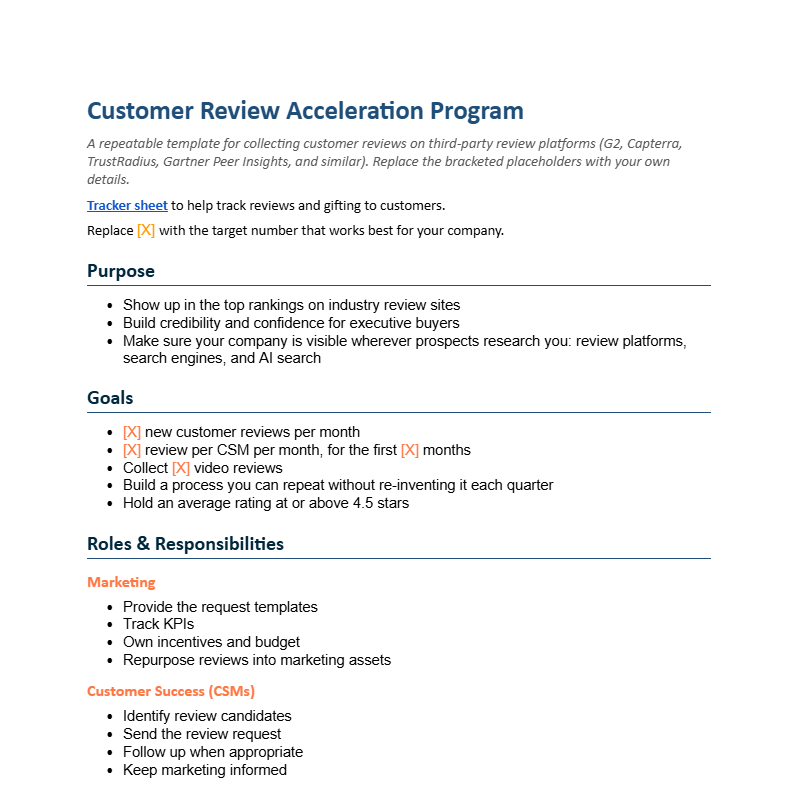
1. The program one-pager (Doc).
Purpose, goals, roles, monthly workflow, budget, and the leaderboard model on a single page.
Fill in the bracketed placeholders, drop your tracker and leaderboard links at the top, and share it with CS as the source of truth.
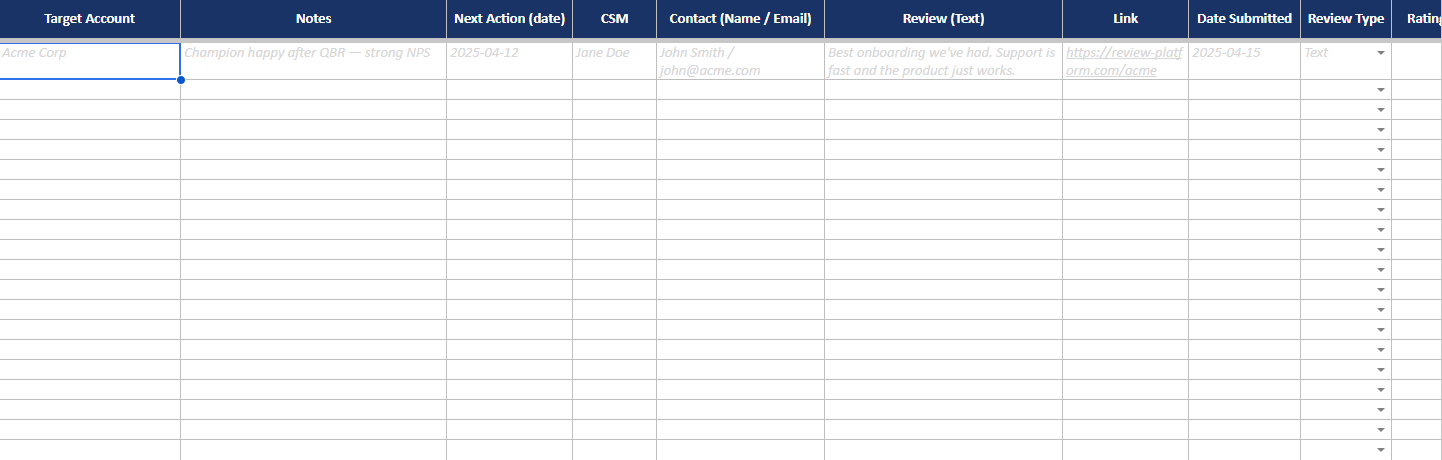
2. The Review Tracker (Spreadsheet).
Review Collection is one row per opportunity, with dropdowns for Review Type, Rating, Gift Card Sent, and Status, so the whole pipeline stays clean as requests move from Pending to Live. Delete the grey example row before you start.
Review Score logs your average rating and total review count by month, so you can watch the trend instead of guessing.
Instructions explains every column for whoever you hand it to.
Happy Review Hunting!
Remember, reviews is a repetitive motion process.
You can’t shoot and forget, at least you can’t do it once and forget.
You need a repeatable framework, a flywheel if you may, that needs to be repeated weekly, monthly, quarterly with heavy ownership.
And… it’s tougher than it looks!
Good luck!